
Every SaaS founder dreams of the moment when everything just clicks. The moment when customers not only use their product but rave about it, renew month after month, and bring in their friends. That magical alignment is called SaaS product market fit, and it’s the holy grail of startup success.
The problem? Achieving it is harder than most founders expect.
You can pour money into acquisition, build feature after feature, and still discover that users quietly churn out the back door. Or find that excitement for your freemium model withers away at the upgrade paywall.
Product-market fit is not luck or marketing tricks. It’s proof that your product delivers undeniable value to the right audience, over and over again.
In this guide, we’ll break down what product-market fit in SaaS really means, the stages your product will pass through on the way, and the metrics that matter. We’ll also highlight some common mistakes that derail founders and see how successful companies like Superhuman and Segment navigated the path.
What SaaS product-market fit really means
For SaaS founders, product-market fit in SaaS is the difference between building a product that gets polite sign-ups and one that drives recurring revenue, retention, and sustainable growth. In other words, it’s the moment when your software doesn’t just solve a problem, it solves it so well that customers adopt it, keep paying for it, and advocate for it.
Unlike one-time product purchases, SaaS success depends on retention. A customer who churns after three months hasn’t contributed much to growth, and if churn outpaces acquisition, your business model collapses. That’s why achieving SaaS product-market fit is more complex than simply confirming initial demand. You need to prove that your software delivers ongoing value, justifies a subscription, and fits naturally into workflows so customers stay loyal.
At its core, SaaS product-market fit is about aligning three elements:
The market: A well-defined segment with urgent, ongoing needs.
The product: Software that solves those needs more effectively than alternatives.
The business model: recurring revenue that grows as adoption deepens.
When these three elements click, you’ve reached true market-product fit, and you have the foundation to scale. But until they do, every other effort, from sales to marketing to fundraising, is built on shaky ground.
How it differs from general product-market fit
While the concept of PMF in business applies broadly across industries, SaaS adds unique challenges. A consumer product might achieve product-market fit when it delights buyers enough for repeat purchases. But for SaaS, the bar is higher. Success means customers are integrating your product into their daily operations, not just testing it once.
This makes retention metrics and churn analysis critical for measuring product-market fit in SaaS. A flashy launch, viral sign-ups, or even a spike in short-term revenue can all be misleading if customers don’t stay. True SaaS PMF is proven when users keep coming back, upgrade over time, and generate expansion revenue.
Using your core value hypothesis to guide development
Your core value hypothesis is the foundation for finding SaaS product-market fit. It defines the specific benefit your product promises to deliver and why your target market will pay for it. Every prototype, feature, and iteration should be tested against this hypothesis: Does it actually deliver the value customers expect?
For example, a project management tool’s core value hypothesis might be that it saves teams measurable time each week. If early customer feedback or usage data shows otherwise, it’s a sign the product needs to be refined before it can achieve sustainable adoption.
By continuously testing and validating your core value hypothesis, you reduce wasted effort and increase your odds of reaching true product-market fit in B2B SaaS.
The stages every SaaS product goes through on the way to PMF
Every successful SaaS company follows a path toward SaaS product market fit that can be broken into clear stages. Each stage comes with its own priorities, milestones, and risks. Rushing or skipping steps is one of the fastest ways to stall growth, while methodically progressing through them gives you the foundation for long-term success.
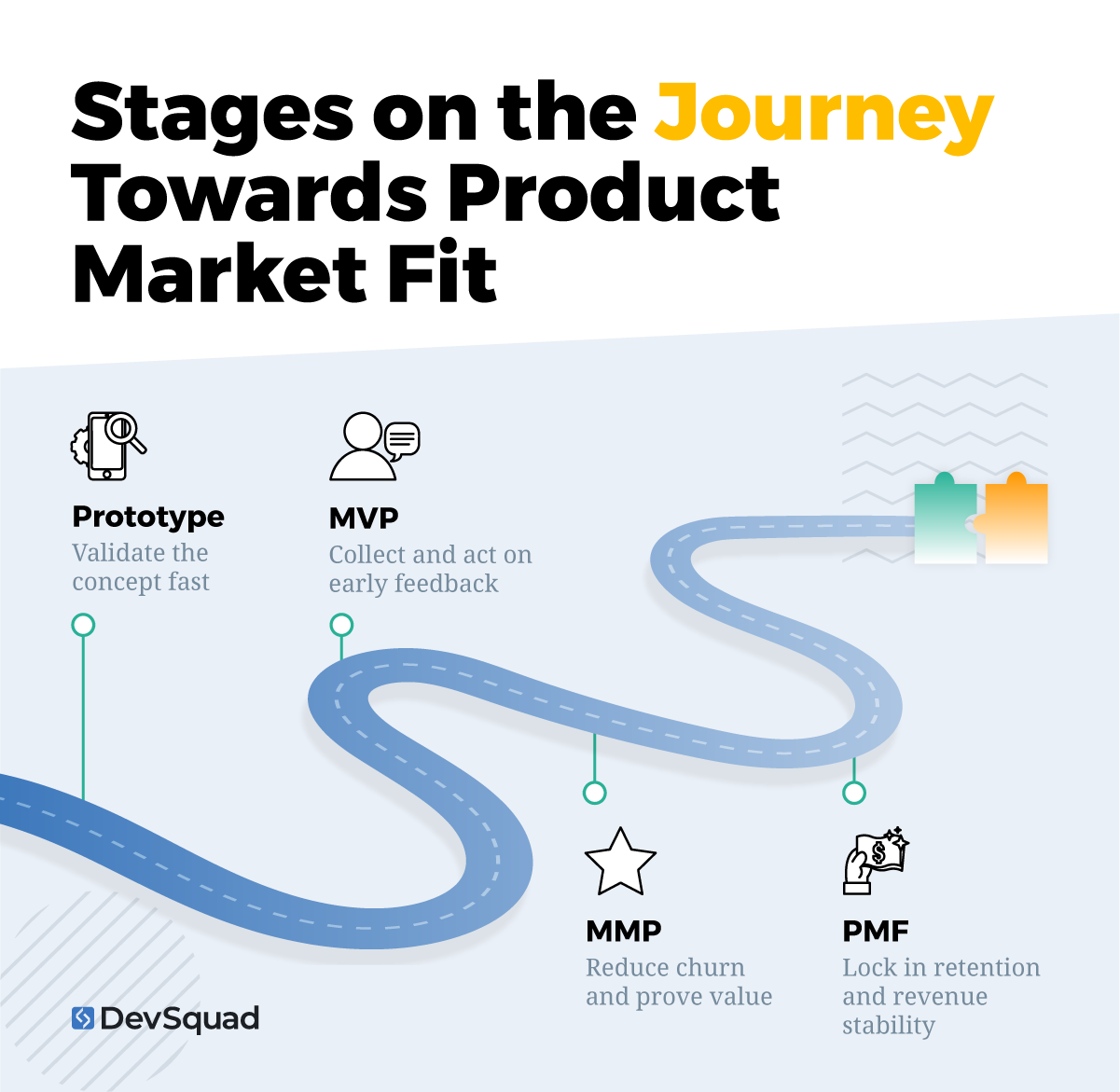
Prototype — validate the concept fast
The prototype stage is about speed and clarity. Before writing production-level code, founders should create a lightweight prototype to test assumptions with potential users. The goal isn’t polish, it’s feedback. Prototypes help you quickly validate whether your core value hypothesis resonates and whether the problem you’re solving is urgent enough to matter.
The best approach is to move in two steps:
Start with a low-fidelity prototype: Sketches, wireframes, or clickable mockups. Use these to test core concepts and user flows quickly. Verify your assumptions, adjust based on feedback, and confirm whether your idea aligns with your target audience’s real needs.
Advance to a high-fidelity prototype: Interactive designs in tools like Figma or no-code apps that simulate the look and feel of your product. Use these to validate usability, design expectations, and perceived value. Again, verify or adjust before investing in development.
By progressing from low-fidelity to high-fidelity, you’re continuously testing your core value hypothesis at each layer, minimizing wasted effort and ensuring your product vision is aligned with user expectations.
MVP — collect and act on early feedback
The minimum viable product (MVP) is the first working version of your SaaS, stripped down to its essentials. Unlike prototypes, the SaaS MVP should be polished and look and feel like the final product. While testing concepts is always part of the process, this stage is more about delivering a usable solution to real customers.
The MVP’s purpose is not to scale but to learn. You’ll release it to early adopters, observe behavior, and start testing whether customers will actually pay for the solution. Analytics, churn data, and interviews begin to shape the roadmap here.
This is the crucial contrast with prototyping: while prototypes help you confirm that your core value hypothesis is sound, the MVP is where you validate it in the real world under the pressure of adoption, retention, and willingness to pay. The MVP is the bridge between theory and reality and your first checkpoint for PMF in business.
MMP — reduce churn and prove value
If the MVP proves that customers will try your product, the minimum marketable product (MMP) proves that they’ll stay. This is the stage where you move from validation to stability by focusing on reducing churn, strengthening onboarding, and ensuring that the product’s value is obvious to users.
Unlike the MVP, which can be feature-light, the MMP should deliver a reliable and well-rounded experience. It includes the core features your target personas depend on, supported by smooth workflows and usability improvements. The goal is to make the product indispensable so it earns its place in a customer’s daily operations.
The milestones at this stage are tied to PMF milestones like retention rates, reduced churn, and expansion revenue. Customers aren’t just testing your solution anymore — they’re integrating it into their processes and often upgrading or adding new seats. This is the stage where product-market fit in SaaS starts to reveal itself in measurable, recurring patterns of loyalty and growth.
PMF — lock in retention and revenue stability
When you reach SaaS product market fit, everything begins to align. Customers not only adopt your product but continue using it, renewing subscriptions, and spreading the word. Churn decreases, retention stabilizes, and revenue growth becomes more predictable. This is the stage where your product is no longer just an experiment — it’s a proven solution with a defensible place in the market.
The signals of PMF go beyond anecdotal enthusiasm. You’ll see sustained improvements in metrics like net revenue retention, cohort stability, and expansion revenue. At this point, your product consistently delivers on its core value hypothesis, your market-product fit is validated, and your business model supports scaling with confidence.
But PMF is not a final destination. Even with strong traction, SaaS companies must treat fit as dynamic. Competitors evolve, customer expectations shift, and new technologies emerge. The most successful teams continue to refine and measure product-market fit as an ongoing discipline, not a milestone checked off once. This mindset allows companies to grow beyond early wins and adapt to future challenges without losing their foundation.
How to measure SaaS product-market fit with confidence
Measuring success in SaaS requires data, and it comes down to tracking the right data. A strong metrics foundation lets you understand not just whether your product is being adopted, but whether it is retaining users, generating advocacy, and driving recurring revenue.
We’ve created a detailed guide to the SaaS metrics every founder and product team should track, but when it comes to SaaS product market fit, a smaller set of quantitative and qualitative signals stand out. Here’s a focused overview of the metrics that matter most for confirming true PMF.
Key quantitative metrics
Here are the primary quantitative metrics to consider:
40% rule for SaaS: If at least 40% of surveyed users say they would be “very disappointed” without your product, you’re likely achieving PMF.
Net Promoter Score (NPS): Gauges satisfaction and willingness to recommend your product, signaling organic advocacy and long-term retention.
Churn rate and retention cohorts: Reveals whether customers continue using your product over time. Cohort analysis helps identify improvements across different groups of users.
MRR growth and expansion revenue: Shows whether recurring revenue is growing not just from new sign-ups, but from existing customers upgrading or expanding usage.
Key qualitative metrics
Here are the primary qualitative metrics to consider:
Customer interviews and usage studies: Provide context behind the numbers, validating whether your product delivers on the core value hypothesis.
Organic advocacy: Referrals, mentions in communities, and unsolicited testimonials show genuine enthusiasm and confirm PMF in business.
Social proof signals: Case studies, positive reviews, and earned media demonstrate trust and widespread recognition in your target market.
SaaS founder mistakes that derail PMF
Even with the right vision, many SaaS founders struggle to achieve SaaS product market fit because of avoidable mistakes. There are some core reasons why startups fail and understanding these pitfalls can keep your head above water and save months of wasted effort.
Scaling too soon
One of the most common mistakes is scaling before proving product-market fit in SaaS. Hiring a large sales team, pouring money into ads, or overbuilding infrastructure can quickly drain resources if retention hasn’t yet stabilized.
Premature scaling often leads to:
High acquisition costs without sustainable revenue
A product that feels unfinished to users
Burnout from trying to support growth the product isn’t ready for
The key is to delay aggressive scaling until you’ve validated PMF milestones like steady retention, consistent expansion revenue, and positive cohort performance.
Confusing free-user enthusiasm with real traction
Free trials and freemium models are popular in SaaS, but they can create a false sense of success. High signup numbers might look promising, but if free users don’t convert into paying customers or long-term active users, the product hasn’t achieved market-product fit.
To avoid this trap, founders should focus on metrics like activation rates, free-to-paid conversion, and retention curves. Free-user enthusiasm should be viewed as a signal — not proof — of PMF in business.
Skipping onboarding and activation work
Even the best product can fail without effective onboarding. New users who don’t reach the “aha moment” quickly are far more likely to churn. Skipping structured onboarding means leaving adoption up to chance, which almost always leads to disappointment.
Strong onboarding and activation work should:
Highlight the product’s core value from the first session
Offer guided steps, tooltips, or product tours
Encourage small wins early, creating momentum toward deeper usage
By investing in onboarding, founders directly support the core value hypothesis and increase the odds of reaching true product-market fit in B2B SaaS.
Using acquisition channels that don’t match your audience
Pouring resources into the wrong acquisition channels can stall growth even when the product itself is strong. For example, enterprise SaaS founders might waste money on broad social ads when their audience is better reached through outbound sales or targeted LinkedIn campaigns.
Choosing channels that align with your ideal customer profile (ICP) is essential. Test channels systematically, measure ROI, and double down on what works. Misaligned acquisition not only wastes budget but can also flood your funnel with customers who churn quickly, obscuring the signals of SaaS product market fit.
How successful SaaS companies found PMF
Superhuman: NPS-driven iteration

Superhuman, the premium email client, is one of the best-known examples of achieving SaaS product market fit through disciplined measurement. Founder Rahul Vohra used the 40% rule survey, asking users how disappointed they’d be if Superhuman disappeared. Early results showed just 22% were “very disappointed,” far from the PMF threshold. Instead of scaling prematurely, the team segmented high-expectation customers, doubled down on features they loved (speed, shortcuts, design), and addressed blockers like mobile access. Within three quarters, Superhuman’s score rose to 58%, proving that systematic measurement and iteration can unlock sustainable PMF in business.
Segment: pivoting to the right market
Segment’s path to SaaS product market fit shows the importance of focusing on the right audience. The company began as a classroom lecture tool, but adoption was weak and retention poor. After reviewing feedback, the founders realized that developers were far more excited about the data-routing API they had built as an internal tool. By pivoting to serve this unmet demand, Segment unlocked rapid adoption and strong retention among B2B customers. This shift validated their core value hypothesis and positioned the company as a leading customer data platform, securing true product-market fit in B2B SaaS.
Figma: Collaboration as the breakthrough

Figma’s success demonstrates how redefining the core value hypothesis can drive SaaS product market fit. Early design tools focused on individual workflows, but Figma bet on real-time collaboration directly in the browser. By solving the pain of version control and disconnected feedback loops, Figma won over design teams and product managers alike. Retention soared as the product became central to team communication, not just design execution. Its viral growth within organizations — designers inviting peers, managers, and developers — proved market-product fit and cemented Figma as the default design platform across B2B SaaS and beyond.
Keeping PMF once you have it
Achieving SaaS product market fit is a breakthrough moment, but keeping it requires just as much attention. Markets evolve, competitors release new features, and customer expectations shift. SaaS companies that see PMF as static often stagnate, while those that revisit it regularly continue to grow.
Run continuous user research and analytics
Regular user research and analytics help you understand whether your product still delivers on its core value hypothesis. Consider:
Cohort analyses to reveal churn patterns
Product analytics to see which features drive retention versus which ones are being ignored
Pairing this data with interviews and surveys helps you anticipate new customer needs before they cause churn.
Expand without overcomplicating your product
Once you’ve validated PMF in business, it’s tempting to grow fast by adding new features. But bloat can dilute your product’s appeal. Smart expansion means layering on complementary features or paid add-ons while keeping the core simple. Figma, for example, grew by adding developer handoff and whiteboarding tools without compromising its design-first experience.
Set up feature requests with tools like Frill to hear first hand what your users are asking for. Pay attention to forums and other areas users might be talking about your product. This will help you gain insight into ways to complement expansion with value.
Watch market shifts and adjust quickly
B2B SaaS is like playing king of the hill. You might have made it to the top, but staying there requires vigilance.
Even with strong product-market fit in SaaS, external factors can disrupt your trajectory. A new competitor, regulatory change, or shift in buying behavior may demand adjustments. To stay attuned to these signals:
Regularly monitor your competitors
Test new pricing or messaging approaches
Revisit your ICP
Make customer success central to retention
Customer success is where PMF is either reinforced or eroded. Teams that proactively help customers get value not only reduce churn but also unlock expansion revenue. That might mean creating onboarding playbooks, monitoring adoption milestones, or engaging power users as advocates. In SaaS, strong customer success isn’t optional. This is how you sustain market-product fit year after year.
Finding the right partner for your SaaS product-market fit journey
Reaching SaaS product-market fit is both the most critical and the most difficult milestone for SaaS founders. It’s the difference between a product that stalls out and one that drives compounding growth. Yet achieving it requires more than passion and vision. It demands structured experimentation, deep customer insight, and the ability to translate feedback into a product that people can’t live without.
For many founders, the challenge isn’t knowing that PMF matters, but navigating the complex path to get there. This is where the right partner makes all the difference. With experience guiding dozens of SaaS companies through PMF milestones, DevSquad specializes in helping founders uncover the right problems, validate solutions, and move confidently toward market traction.
Our Design Sprint process is built precisely for this stage: rapidly testing your core value hypothesis, aligning your team around customer needs, and producing a validated prototype in just days — not months. It’s a proven way to accelerate your path to achieve SaaS product-market fit while avoiding costly detours.
Ready to find your SaaS product-market fit and build a SaaS product? Learn more about our SaaS design agency.

Dayana Mayfield is a SaaS copywriter and content marketer specializing in SaaS marketing, positioning, and go-to-market strategy. She has consulted for over 195 SaaS companies, focusing on both traffic and conversions. She has been featured in Entrepreneur, Forbes, and Business Insider. Outside of work, Dayana writes SciFi novels and spends her evenings surviving auditions, rehearsals, and tech week as a proud theater mom.