
What are the top SaaS market trends that we can expect to see in 2025?
Well, SaaS itself is trending.
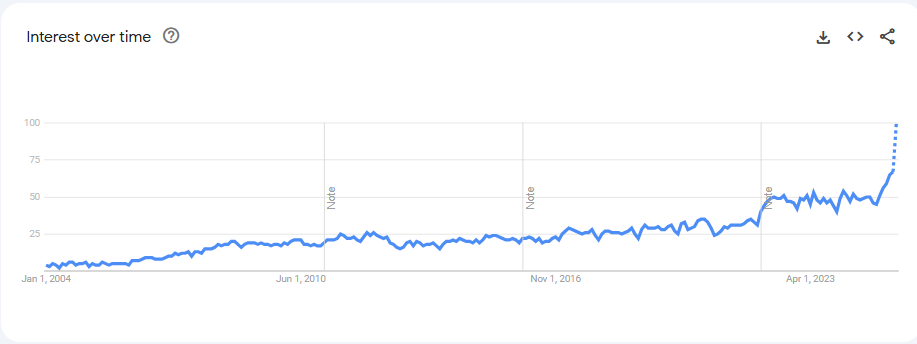
As we can see from this Google Trends report, search queries for “SaaS” are going up and up. According to Google Trends, interest in the term has grown steadily since 2004.
The top trends driving SaaS market growth
SaaS industry growth isn’t slowing. Companies spend an average of $8,700 per employee on SaaS (more than they spend on laptops or computer for employees), and as more industries adopt SaaS, that number is rising.
The software as a service market size has even outpaced projections. In 2020 it was expected to reach USD 307 billion by 2026. Now in 2025, the SaaS market size is expected to reach USD 390 billion by the end of the year.
All of this growth in the current state of the saas market is being driven by three core trends:
AI-powered SaaS products luring business buyers with the promise of increased efficiency and reduced manual work
Increase in mobile, tablet, and laptop device usage around the world
Private and public sectors being ready for cloud software that all staff (office and boot on the ground) can access from anywhere
13 SaaS market trends and opportunities you need to know about
All of that market growth is exciting. But how do you tap into it? What types of SaaS products should you build or invest in in 2025? We've got the answers.
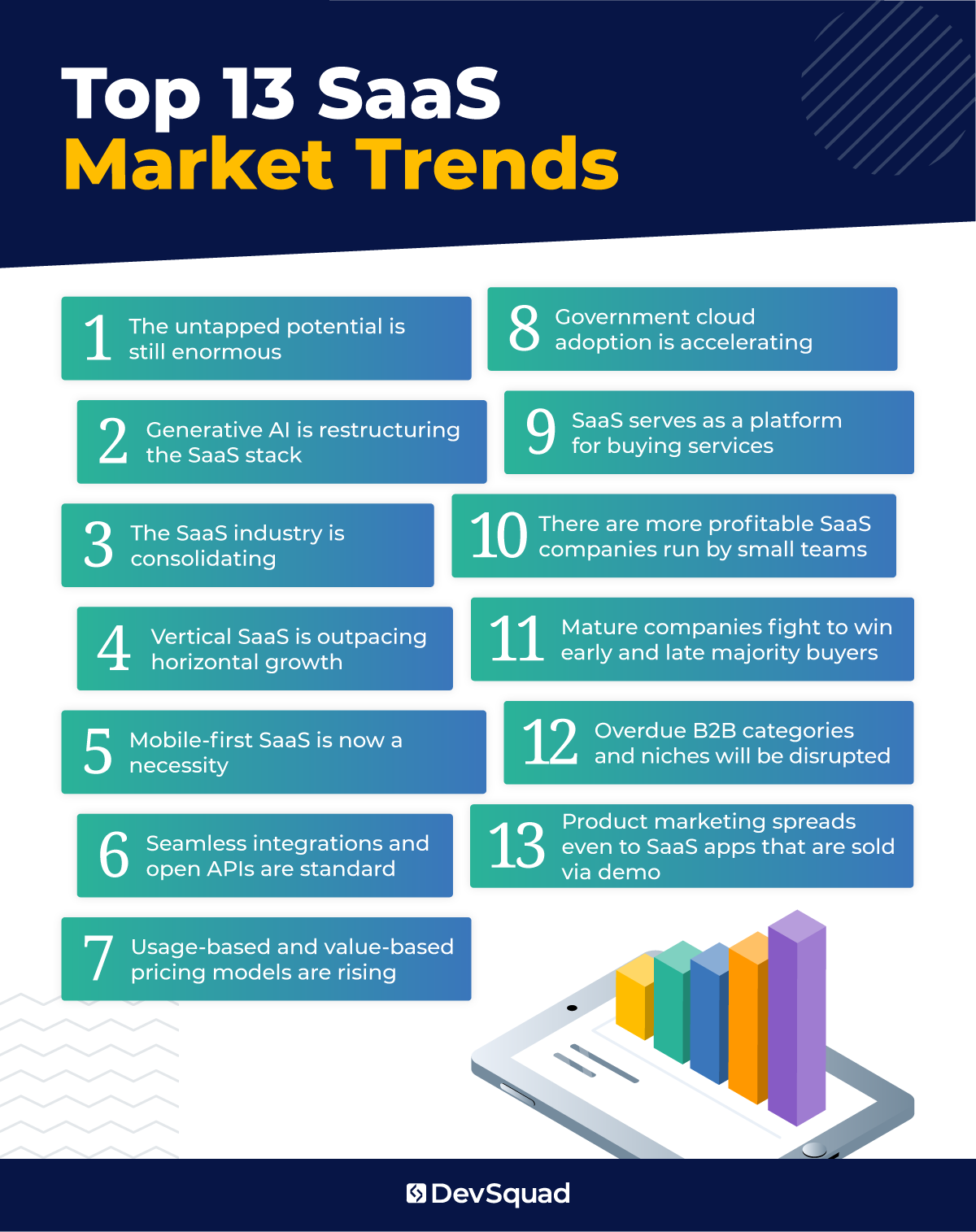
Here are the top SaaS market trends for 2025:
The untapped potential is still enormous
Generative AI is restructuring the SaaS stack
The SaaS industry is consolidating
Vertical SaaS is outpacing horizontal growth
Mobile-first SaaS is now a necessity
Seamless integrations and open APIs are standard
Usage-based and value-based pricing models are rising
Government cloud adoption is accelerating
SaaS serves as a platform for buying services
There are more profitable SaaS companies run by small teams
Mature companies fight to win early and late majority buyers
Overdue B2B categories and niches will be disrupted
Product marketing spreads even to SaaS apps that are sold via demo
These SaaS opportunities are ripe for technical founders, entrepreneurs, job seekers, and investors.
1. The untapped potential is still enormous
It’s a fact: there is still so much untapped potential for SaaS companies. One SaaS investor believes there’s so much potential, that there should be 100 times more SaaS companies than are currently on the market.
This isn’t unbridled optimism.
There’s still a lot of unsolved pain points in SaaS, and businesses pay money to have their problems solved. Just talk to your friends and family members with jobs. You won’t have to chat for too long to find processes, tasks, and even entire roles that are manual, time-consuming, or otherwise unoptimized.
2. Generative AI is restructuring the SaaS stack
Generative AI has created a fundamental shift in how software is designed, delivered, and used. It’s collapsing the SaaS stack from three layers (interface, logic, and data) into one intelligent layer powered by AI models.
In traditional SaaS products, humans interact with a user interface, which connects to a logic layer and a data layer. But generative AI makes that multi-layered experience obsolete. In an AI-first setup, there’s no need for forms, dropdowns, or human-triggered workflows. Instead, the AI can parse unstructured data (emails, transcripts, receipts), apply context-aware logic, and update records autonomously—no manual input required.
That means fewer seats sold, less friction, and completely new use cases.
Companies like Klarna are leading the charge, replacing legacy SaaS platforms like Salesforce and Workday with internal AI tools. In one example, Hitachi used an AI agent to unify HR services across four business units and 120,000 employees—achieving 70% efficiency gains in just eight weeks.
And the economic impact? It's coming fast. Analysts expect a 15–20% drop in SaaS software seats by 2026, as AI allows companies to consolidate tools and reduce headcount dependency.
Every layer of the SaaS stack is being reimagined:
Interface: Natural language replaces screens and clicks.
Logic: Business rules are inferred and executed by AI context.
Data: Structured databases give way to AI-optimized data architectures.
The implications are enormous. For startups, this is a greenfield opportunity to build smarter products without decades of legacy baggage. For incumbents, bolting AI onto legacy systems won’t be enough. This is a platform shift, not a feature war.
We can also expect that ai impacting market trends will continue for the foreseeable future.
3. The SaaS industry is consolidating
After years of app sprawl, consolidation is reshaping the SaaS landscape. The average number of SaaS apps per company dropped from a peak of 371 in 2023 to 220 in 2024—a dramatic 40% decline. Businesses are no longer looking to stack dozens of single-use tools. They’re streamlining platforms, reducing redundancy, and cutting costs.
There are two forces driving this shift:
Buyers want fewer, smarter platforms. Companies are choosing broader solutions that combine multiple functions, especially those with native AI capabilities. Rather than juggling five apps for sales enablement, teams want one that can handle outreach, forecasting, and analysis with AI at the core.
Vendors are merging to stay competitive. Legacy providers are acquiring niche tools in hopes of quickly filling feature gaps. But bolted-on innovation often fails to deliver a cohesive experience, especially when AI-native startups are offering fluid, integrated workflows from day one.
This trend is especially critical for founders. SaaS businesses with a narrow feature set—and no compelling integration or data advantage—are most at risk. Seat-based pricing models are already under pressure from AI; app bloat only accelerates churn.
Meanwhile, savvy buyers are standardizing around fewer vendors, negotiating enterprise-wide contracts, and pushing for deeper value from each tool they keep.
4. Vertical SaaS is outpacing horizontal growth
Ever heard the saying “the riches are in the niches?” With SaaS, that’s still true—and even more so now. Vertical-specific SaaS companies continue to represent the largest and fastest-growing segment of the market.
In case you’re unfamiliar with the lingo: a vertical SaaS product is built for a specific industry (like appointment software for dental offices), while horizontal SaaS tools serve a function used across industries (like email marketing).
Business owners and employees prefer tools designed for the specific needs of their industry. They’re easier to adopt, often simpler to use, and typically offer better ROI out of the box. Vertical SaaS companies also benefit from streamlined marketing—messaging can speak directly to pain points, which helps improve conversion and reduce acquisition cost.
Plus, with AI and automation now more accessible, niche SaaS companies can deliver enterprise-level capability without needing a massive team or years of development. The barrier to entry is lower—and the addressable market is clearer.
5. Mobile-first SaaS is now a necessity
A few years ago, mobile optimization was a nice-to-have. In 2025, it’s a baseline expectation.
Mobile devices generated over 58% of global web traffic in Q1 2023—and that number continues to grow. Users aren’t just browsing—they’re managing workflows, collaborating with teams, and making purchase decisions from their phones. SaaS providers that don’t deliver a seamless mobile experience are getting left behind.
The trend isn’t limited to consumer-facing apps. In traditional industries like insurance, construction, agriculture, and real estate, employees depend on mobile interfaces to complete tasks on-site. A responsive dashboard isn’t enough. These users need full functionality and intuitive UX built specifically for mobile.
A great example of this mobile-first approach is FieldData which has created a service for managing livestock operations through WhatsApp. This allows ranchers to track critical information by texting or voice recording while they are in the field getting things done.

Modern SaaS companies are adopting a mobile-first development approach, meaning they design for smaller screens first, then scale up for desktop—not the other way around.
6. Seamless integrations and open APIs are standard
Seamless integrations are now the expectation. Today’s SaaS buyers want products that fit easily into their existing tech stack. Whether they’re working with project management tools, CRMs, or analytics platforms, the ability to connect systems out of the box is critical.
Buyers evaluate new SaaS products through the lens of interoperability. Can it plug into Slack? Zapier? HubSpot? If it doesn’t, they’ll move on to one that does. One study found that 93% of startups list the integration features and API access clearly in their pricing plans clearly. And as part of the broader trend toward transparency and usability, integrations now play a role in purchase decisions just as significant as price.
SaaS companies are responding by providing:
Direct integrations with popular industry tools
A SaaS API that allows customers to make better use of the product
A Zapier integration so that 8000+ integrations are available to customers
While this trend has been going on for a while, what’s changed is the baseline. Integrated functionality is now a default setting, not a differentiator. Customers don’t want to build bridges—they want to walk in and start working.
7. Usage-based and value-based pricing models are rising
SaaS companies are moving beyond fixed subscriptions.
While subscription pricing still dominates, more companies are experimenting with usage-based and value-based models. These models make it easier to charge in a way that matches how much value a customer gets—or how often they use the product.
Three out of five SaaS companies are now offering or testing usage-based pricing. In a separate study, 39% of SaaS companies said they prefer value-based pricing, while 38% favor usage-based pricing.
We’re also seeing pricing become more personalized. Some companies offer multiple tiers and usage triggers to meet different customer needs. Others provide free plans or discount incentives to move prospects through the funnel. Whatever the structure, the goal is the same: let customers pay for what they use and what they need.
8. Government cloud adoption is accelerating
Public-sector organizations are ramping up their use of cloud infrastructure. Most government IT leaders now rely on hybrid and multi-cloud environments, and a growing number are migrating legacy systems to the cloud.
A full 80% use hybrid cloud, 71% use multiple public clouds, and 27% of government decision-makers say their top priority is migrating existing workloads in the next 12 months.
Security remains a key driver. So does modernization. And migration from legacy systems sits on top of the challenges of adoption. But where there are challenges, there is opportunity. In the US alone $90 billion are annually allocated by federal departments for IT expenses.
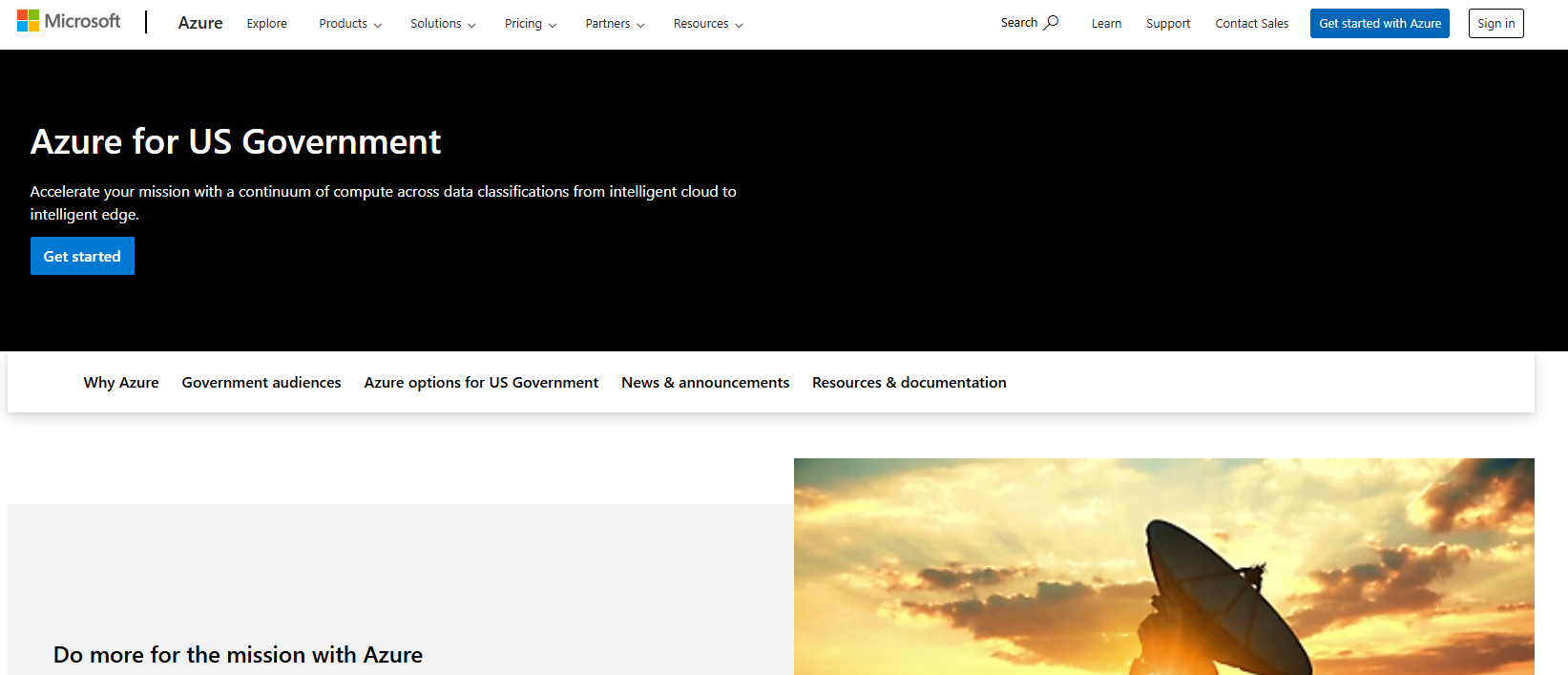
Many of the major players have also created custom solutions for government applications. For example, Microsoft Azure Government, is a dedicated cloud platform that is isolated from other Microsoft’s cloud services to ensure compliance with strict federal requirements.
9. SaaS serves as a platform for buying services
We’re fully in the era of service + tech.
In January of 2007, the first iPhone was released. In March of 2009, Uber was launched. Uber was one of the first examples of people utilizing mobile technology to acquire a service. Now, of course we have Doordash, Priv, and many others.
Similarly, there are many SaaS products that are being built in order to acquire a service. Here are some examples:
FreeeUp - The FreeeUp software was built so entrepreneurs and small business owners could get paired up with freelancers in the Philippines and US, and manage their payments.
Showdigs - Showdigs is a web app that lets busy property managers request that nearby real estate agents handle vacancy showings for them. The real estate agents get notified of new showings with prospective renters via a mobile app.
SocialBee - In addition to the robust social media scheduling features, SocialBee also allows you to purchase social media management service from their network.
Penji - For a flat monthly fee, their platform lets you request images from a graphic designer and review and comment on designs.
Services are a great, reliable business model. In 2025, even more entrepreneurs will innovate new ways to build scalable service companies inside of easy-to-use SaaS platforms.
10. There are more profitable SaaS companies run by small teams
Ever heard of a little thing called micro-SaaS? This is simply a software as a service company that is owned and operated by a single person or a small team.
There are thousands of small business SaaS companies that are bootstrapped and profitable. In 2025, even more entrepreneurs will realize that a SaaS company doesn’t have to have a billion dollar valuation or VC-backing in order to be a great business.
These entrepreneurs will aim to build a company that covers salaries and expenses, provides a generous profit, and has the potential for a favorable exit.
Another successful area for small teams creating profitable SaaS companies is in the vertical SaaS market we discussed earlier—especially for experts in the different fields. Everything from shipping and logistics to accounting and legal are ready to adopt products that solve their problems.
11. Mature companies fight to win early and late majority buyers
Who wants to be the next Salesforce?
Salesforce was founded in 1999, and now it owns a whopping 20.7% of CRM market share despite having hundreds of competitors.
Mature companies will continue to fight in order to win the early majority and late majority buyers (the big chunk of B2B buyers between the early adopters and laggards).
Profitable, established SaaS businesses will build additional features and pricing tiers that allow them to move upmarket and win bigger fish.
While winning early and late majority buyers doesn’t always mean going upmarket, this is often the case, because bigger companies are harder to sell to. They have more requirements and more decision makers, and they are less likely to take a chance on a younger company. In 2025, going upmarket and gaining market share will be a huge SaaS industry trend. So expect to see a lot of changes in the marketing approach for companies that you were an early adopter of.
12. Overdue B2B categories and niches will be disrupted
This B2B SaaS trends is never going away: a painful process is discovered, and dozens of companies emerge to fix it.
The hottest SaaS opportunities are those that serve businesses and industries who are long overdue for innovation.
Ten years ago, legal tech had an enormous boom, with so many law firms going digital for the first time.
In 2019 and 2020, some of the top opportunities for disruption are in business travel software, property management software, real estate software, OKR and KPI tracking, and other underserved, overly manual industries such as early education and medical.
Now in 2025, LLMs and AI agents are taking shape and causing a reevaluation of what’s overdue. Disruption can now come from addressing legacy systems to transforming the way businesses interact with their data.
Do you know of an old-school industry that’s ready for innovation? We can help you with SaaS development.
13. Product marketing spreads even to SaaS apps that are sold via demo
By now, we’re all well aware that SaaS buyers want to test out and play with products before they buy them. Product-led growth marketing means using the product as a key acquisition channel. Freemium plans and free trials let users experience the product, and they may later convert to a paying customer.
But what about SaaS products that are exclusively sold via demo?
These B2B buyers still want to explore the product. To satisfy this desire, more SaaS companies (that have inside sales teams) will create interactive product demos or small side-project apps to bring in curious leads and later convert them.
Key takeaways
As the SaaS market grows, the trends will change. In 2025, we expect to see more applications of AI and the development of vertical SaaS products. SaaS consolidation is expected to continue, but room is always open for new disruptors that solve real problems.Enterprises will continue to prioritize ways to gain a cutting edge, while expecting user-friendly product design. These trends will affect how SaaS entrepreneurs build products that capitalize on untapped potential.
Overall, the future of SaaS technology is looking bright.

Dayana Mayfield is a SaaS copywriter and content marketer specializing in SaaS marketing, positioning, and go-to-market strategy. She has consulted for over 195 SaaS companies, focusing on both traffic and conversions. She has been featured in Entrepreneur, Forbes, and Business Insider. Outside of work, Dayana writes SciFi novels and spends her evenings surviving auditions, rehearsals, and tech week as a proud theater mom.