
Product validation helps you to be 100% certain that what you’re building has market demand. This can strengthen your commitment to your business while keeping you laser focused on the actions that will get you to market faster.
Without real product validation, you’re essentially throwing resources into a lottery and hoping you hit the jackpot.
Product validation is important for everyone making anything they want to sell. And it takes different forms depending on the product you're making. For instance, in B2B businesses the simple cost-effective methods of the lean product validation process help eliminate unnecessary building.
But here I go getting ahead of myself. Let’s take a step back and start from the beginning. That is, what is product validation and why it matters. From there we will dive into the 10 step product validation process we’ve come to love, present options for obtaining the data you need, and discuss what validation processes are the best for each industry.
Let’s dive in.
What is product validation?
Product idea validation is the process of ensuring there is market demand for a product before investing in manufacturing or development. Established brands and new entrepreneurs alike need to validate products to reduce the business risks of creating something that no one wants to buy. When products fail, it can lead to major profit losses—or even business closure and bankruptcy.
With the stakes so high, it's important to use a variety of product validation strategies, including customer research, competitor research, social media listening, and pre-orders. For digital products like apps and software, prototyping and UX interviews are essential to ensure that users connect with the product concept, find it valuable, and are willing to pay for it.
Some products should be validated on their ability to solve a problem for customers, while others should be validated with marketing interest data to ensure that it meets an emotional or entertainment need.
Why product validation matters
Product validation is a critical first step for building any new product or business. It benefits the entrepreneur, the company, the team, and the customers.
Entrepreneur benefits - Invest money in something that is nearly guaranteed to see a return.
Team/company benefits - Understand the strategic product vision, increase decision maker buy-in, and decrease confusion, disagreements, and unnecessary pivoting.
Customer benefits - Feel understood by the company and get their needs met.
Very few companies and entrepreneurs can be successful without validating their product first.
Companies around the world rely on very distinct processes to ensure that they’re not building what only one person thinks is a good idea. While these distinct processes exist, there is an overarching structure to the validation process.
We’ve found the process can be broken into 10 distinct steps. And yes, this may seem more complicated than what others may be saying, but when you read between the lines—or steps—there is more going.
The 10 steps of product validation
Now that you understand what product validation is and why it matters, it's time to put it into action.
Below, we walk through a 10-step product validation process that moves from defining your concept to testing real demand—without wasting time or money building the wrong thing.
Step 1. Clarify your product concept and business objectives
Every successful product starts with a clearly defined idea and purpose. Before you dive into user interviews or prototypes, you need to articulate the problem you're solving, who it's for, and how the solution aligns with your business goals.
For the lean product validation process, this step is associated with identifying the problem you are solving:
Problem - First, you need to validate the problem. Is this a big problem? Is it an important problem? You can discover this by interviewing potential customers.
Where the problem addresses the clarity in your business objectives is also necessary before moving on.
Before you begin validating anything, align your product idea with your business goals.
Ask yourself:
What type of business am I building—lean and profitable, high-growth, or niche and bootstrapped?
What kind of customer behavior will define success?
What’s the end goal for this product—acquisition, recurring revenue, market leadership?
This level of clarity helps you stay focused throughout the entire validation process and avoid chasing feedback that doesn’t align with your broader goals. There is no one shoe fits all here so clarity and perspective are going to be your best friends.
Step 2. Define your ideal customer and market segment
After validating that the problem is real and meaningful, the next step is to figure out who exactly you’re solving it for. Defining your target market early helps you avoid collecting feedback from the wrong people and wasting time on a solution that doesn’t match the needs of your best-fit users.
Not all users experiencing a problem are the right ones to build for. Some markets are too small, too expensive to reach, or already saturated with well-loved alternatives.
Market – Are the potential customers you interviewed the best market for you to enter? Or is there another market that is experiencing this problem in even greater numbers, or with greater intensity?
Try to keep an open mind in this step. You may find that the ideal market is not what you initially thought. Consider whether your ideal market is:
Underserved and looking for a better way
Overwhelmed by clunky enterprise tools and open to simpler solutions
Easy or difficult to reach through marketing channels you already know
This is also the time to conduct keyphrase research. It is a super easy idea that you can do for just about any product or niche. Conduct keyphrase research with a free SEO tool like Ubersuggest. How many searches per month are conducted for the shortest tail variation of your concept? How many searches per month are conducted for commonly asked questions and major customer pain points?
 You can also look into Google Trends, to see if the topic is trending up or down.
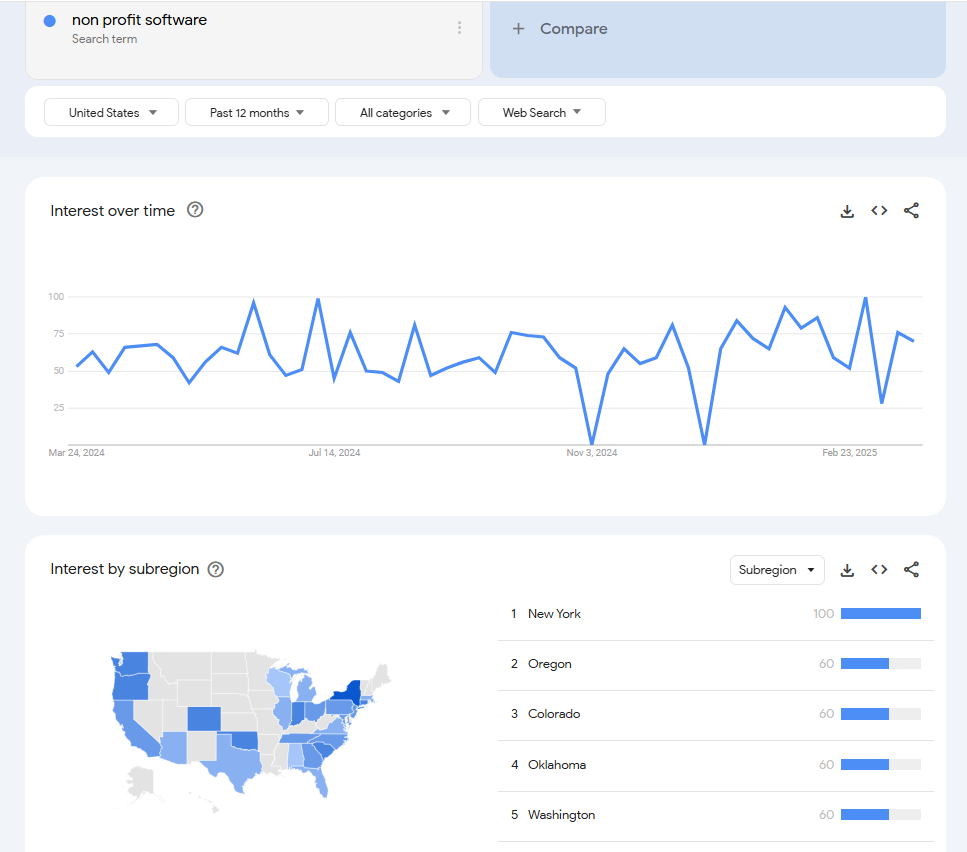 Validating the market at this stage helps you test your assumptions with the right users and make product decisions that align with their specific context and needs.
The keyphrase research ensures that you have the right vocabulary to talk to your target users about the problem.
Step 3. Conduct customer discovery interviews
Speaking directly with potential users is one of the fastest and most effective ways to validate your product idea. These conversations reveal how your audience currently solves the problem you want to address—and whether they’re dissatisfied enough to consider switching to something new.
Before undergoing any investment into product validation, you should exhaust all of your free options. One of the most important things you can do is to interview potential customers and ask the right questions.
Find out how they are currently handling what your software product would provide. You might discover that although there isn’t any software on the market, they are very pleased with using spreadsheets and wouldn’t pay for what you want to sell.
This step isn’t about pitching your idea. It’s about listening and uncovering truth. The more honest feedback you gather now, the better your decisions will be down the line.
When conducting interviews:
Focus on learning what users are doing today—not how they would react to your product.
Ask about their current tools, workarounds, frustrations, and priorities.
Resist the urge to sell or explain your concept too soon.
Aim to speak with 5 to 10 people who match your ideal customer profile. If the feedback reveals that the problem isn’t important—or already well-solved—this is the time to pivot.
If your goal is to gain external funding from an investor or potential business partner, show them that the market is interested in your concept.
Step 4. Create a low-fidelity prototype.
Before investing in design and development, it’s smart to explore your product idea visually. A low-fidelity prototype allows you to mock up the experience and test ideas early—without wasting time or budget.
This type of prototype isn’t polished or interactive, but it gives your concept just enough shape for feedback. They could be paper drawings, or a PNG mockup, or PDF of the UX.
The goal is to get the best possible sense of the product before you open your wallet. And while low-fidelity prototyping is a good option for everyone, it’s an essential step for software and apps.
It allows you to discover....
Whether or not it would solve users' problems
If they like it better than their current software or process
If they would switch over to it
What they would be willing to pay
If there are any missing features that it must have in order for them to switch
If there are any missing features that aren’t a dealbreaker, but they would like to have
Here's an example low-fidelity prototype from one of our client projects. This screen is showing an in-progress delivery route. As you can see, the UX layout appears as it would in the final version, but we don't worry about the design in terms of logos, colors, fonts, etc.

Step 5. Get early user feedback and refine your concept
After creating a low-fidelity prototype, the next step is to get early feedback. This doesn’t require extensive testing—just real reactions from people who match your target market.
The goal is to learn quickly: Is the concept clicking with users? Are you missing a key feature? Is there something that turns people off entirely?
In addition to the low-fidelity prototype, another option is to build a “smoke-test” landing page.
While smoke testing and landing pages will be covered more in Step 8, at this stage you're mainly aiming for directional insight.
Start by showing your early prototype or concept (even just screens or sketches) to a small group of potential users and asking:
What confuses them?
What’s missing?
What seems valuable or exciting?
As is the case with every step, be ready to adjust based on what you hear or find. Your initial idea is just a starting point. This step is about learning what needs to change before you invest in more polished prototyping or development.
Step 6. Build a high-fidelity prototype
Once your concept and direction have been validated through research and early feedback, it’s time to bring your idea to life with a high-fidelity prototype. This version should closely resemble the finished product in look and feel, and be interactive enough for users to click through key flows and features.
This is where abstract ideas turn into tangible user experiences.
High-fidelity prototypes - These prototypes are as realistic as possible. They are very close to what the UX of the MVP of your software product would look like. However, they don’t actually function. The user might be able to click around the menu navigation a bit, but the feature set won’t be completed on the backend.
Think of your high-fidelity prototype as a visual MVP. You're not aiming to simulate your full product—you’re showing the smallest version of it that can deliver core value. This mindset helps prevent feature bloat, sharpens your testing, and moves you closer to something you can eventually launch.
Creating a high-fidelity prototype allows you to:
Demonstrate the core UX and flow of your product
Prepare for usability testing with minimal technical lift
Validate emotional response to the look and language of the product
Identify friction points in key user journeys
You don’t need a functioning backend or full feature set yet. You just need something real enough that users can engage with it and give meaningful feedback.
Step 7. Test the high-fidelity prototype with real users
With a polished prototype that reflects your MVP concept, it’s time for product verification testing to observe how real users interact with it. This step is all about identifying usability issues, unmet expectations, and emotional reactions—before you commit to development.
During this validation phase, you’ll conduct user testing with real prospective customers. These should be people who are in the same role or business type as your target customer.
You’ll show the prototype to the users and have them interact with it. Make sure that they know that they are not being tested, the software is being tested. You don’t want users to feel like they are being watched to check their tech prowess. Rather, you want them to feel comfortable stating what they would change about the UX, and what features they would prioritize.
To run a strong test session:
Recruit 3–5 people who match your ideal user profile.
Ask them to complete key tasks using the prototype while you observe silently.
Record the screen and their reactions (with permission).
Only ask clarifying questions after the test is done.
If multiple users struggle in the same place, it’s a sign that part of the UX needs adjustment. Capture those insights, make your changes, and consider a second round of testing if needed before you move forward.
Step 8. Run marketing experiments to validate demand
Once you’ve validated your concept with real users, it’s time to test whether people will actually sign up or pay for it. Marketing experiments—like smoke test landing pages, waitlists, or pre-orders—help you gauge interest from a wider audience and gather real behavioral data.
This goes beyond opinions and into market behavior.
Smoke test landing page
Creating a landing page before you build your software is known as smoke testing, and it's one of the most effective strategies for SaaS entrepreneurs.
Before Joel Gascoigne built social media scheduling app Buffer, he first created a landing page to pre-sell it. After people clicked to view plans and pricing, they were then taken to a page that said that the product wasn’t ready for purchase yet. Interested users could then leave their email address to be notified of when the app launched.
This strategy allowed Joel to check that people were actually interested in this product. He could check the amount of traffic to the page and the conversion rate from browser to registrant.
 Here’s an example from our own new software, RaiseIQ, which started as a solution that helps startup entrepreneurs build financial models for their pitch decks.

The results of the smoke-test ultimately transformed RaiseIQ. We found that what’s important was a full scale support model to help experts in their respective fields. The result—a startup venture studio designed for entrepreneurs to conquer their verticals.
“That’s what’s so great about a smoke test landing page…. You can test not only the concept, but also yourself.”
While this strategy is popular in the SaaS world, it can work in any industry.
Pre-orders
If you're launching a new version of an existing product, you might decide to collect real pre-orders. You should only do this if you know you can fulfill these orders. (If you already have a trusted manufacturer, warehousing, and packing and shipping processes in place.)
This is a great form of product validation because you can set a minimum number requirement to help you decide to move forward with the product.
For instance, let's say you expect to get 200 pre-orders from a certain number of social media posts or email blasts. This shouldn't be an arbitrary goal, but rather based on previous success metrics from your marketing campaigns. If you hit that limit, you'll move forward with production and fulfill those orders. If you don't get the reaction you're expecting, then you'll refund those pre-orders with a polite message, cancel the product launch, and consider a different approach.
Here's an example pre-order promotion from fragrance company Riddle. They're adding a brand new fragrance to their product line:

Step 9. Decide whether to pivot, iterate, or move to development
At this point, you’ve collected insight from real users, tested your prototype, and validated demand through early marketing signals. Now it’s time to make a decision: Are you moving forward with development, adjusting your direction, or going back to the drawing board?
Use all the data you’ve gathered—from interviews, prototype testing, and landing page conversions—to evaluate where your product stands. Consider these questions:
Did users understand the product’s value right away?
Are people excited enough to sign up, pre-order, or join a waitlist?
Did any major UX issues or dealbreakers surface during testing?
Is there evidence of strong demand from the right market segment?
If your concept received strong feedback and measurable traction, you're ready to proceed to development. If results were mixed, consider iterating—adjust your feature set, target audience, or messaging, and then re-test. And if feedback consistently points to a weak value proposition or low demand, it may be time to pivot entirely or shelve the idea for now.
This step is not about perfection—no product is ever fully “ready.” It’s about having enough clarity and validation to move forward without guessing.
Step 10. Continue validating throughout development
Product validation doesn’t stop when you start building. Validation methods must continue to be applied. The most successful teams keep learning, testing, and adjusting throughout development. Every sprint is an opportunity to uncover insights and refine what you’re building.
As you move into development, continue to:
Conduct usability testing on new features before and after release
Interview users regularly to validate roadmap priorities
Monitor engagement and retention metrics to confirm value delivery
Use A/B tests and in-app feedback tools to guide decisions
This mindset—often called continuous discovery or continuous validation—helps you stay aligned with real user needs instead of building from assumptions. It also reduces costly rework, shortens time-to-value, and makes the product stronger with every iteration.
Building a validated MVP isn’t a finish line—it’s a launchpad.
17 ways to gather product validation data
As we’ve previously discussed, product validation is going to look differently for different industries. And while the step-by-step process is mostly generic, the way in which you gather data is going to depend on the who, what, how and why that shapes your business.
You can use a variety of methods to vet your product concept before you invest in it.
Here are some of best ways to collect product validation data:

1. Competitor research
See what your competitors are up to. In most cases, a healthy amount of competition means there is plenty of need for a product. If there aren’t a lot of competitors, your idea is either not worth creating or you are very ahead of your time.
You can dig into your competitors’
Corporate financial reports
Social media followings
Number of employees
Use this information to suss out the probable success of your competitors. Then, alter something about the product or target market to carve out your own niche.
2. Customer interviews
Customer interviews are one of the most important product validation techniques. You can find target customers online and reach out to them to request an interview. To increase participation, you might offer a gift card in exchange for their time.
Ask them:
What they like and don’t like about a similar product to yours
What they like and don’t like about your product concept
How much they’d be willing to pay for your product concept
Any changes they’d make and why
3. Surveys
You can also send product research surveys. Create a survey with a tool like SurveyMonkey or Typeform.
Then, build a list of target customers yourself or enlist the help of a market research company to find target customers for you.
The more you’re planning on investing into product development, the more data you’ll want to collect. There’s no right answer, but you’ll probably want to get anywhere from 100 to 1,000 survey submissions.
4. Focus groups
A focus group is a group of target customers that you can chat with to get their opinion on your product. Unlike surveys and interviews, where customers respond to your questions alone, a focus group brings people together to foster open-ended discussions.
This is a great strategy if your product concept isn’t totally nailed down yet. Maybe you’re unsure about how to solve a specific problem, or which direction to take your product. By getting your target customers to discuss these issues with you, you can come to better decisions.
Then, you can use other strategies on this list to validate your unique idea.
5. Pre-orders
When people vote with real money, you know that the product validation data you’re collecting is legit.
Create a simple order form or a well-designed, branded landing page to take pre-orders.
Then, count the number of pre-orders you receive and gauge that amount against how challenging it was to market the landing page and how much you spent on marketing.
6. Email marketing campaigns
Not only can you collect data on the number of pre-orders, but you can also monitor the marketing channels you use to promote your product.
Email marketing is one of the best channels to use when validating a new product. If you already have an audience, you can email them all of the details about your new product--why you’re creating it, what it is, etc.
If this is a completely new venture, you can start building up an email audience through social media and paid advertising.
Collect data on:
Email newsletter opt-in conversion rates
Cost per new email subscriber
Email open rates
Click-through rates
Unsubscribe rates
All of this data will show you how interested your audience is in your product.
If you’re getting a lot of engagement on your emails but not a lot of pre-orders, that could be a sign that your pricing is too high or that your product isn't all that desirable.
7. Social media post engagement
You can also track engagement on your social media posts. Try announcing your new product on your social media channels and see how people react.
Do you get more comments and engagements than your typical content? Or far less?
Are the people leaving comments truly excited or are they just pandering?
Of course, in and of itself, social media post engagement isn’t enough data to decide whether or not to move forward with a product. But it can help provide anecdotal, qualitative data to provide more context to some of these other data sources.
8. Social media polls
You can also poll your audience on social media. Simply create a native poll inside of Twitter or LinkedIn, and see what your audience has to say. You might ask them to vote on a certain product version, name, feature, or color.
9. Social listening
With over a billion people on social media, there's an enormous amount of data being generated every day. Social media contains everything you could want to know about your target audience. What they love. What they hate. What they're willing to buy. But analyzing that data is a ton of work. It's smart to use a combination of manual research and social media intelligence tools to help you process more data in less time.
For instance, StatSocial can be used at every stage of product development. The platform employs advanced algorithms and machine learning techniques to analyze social media data from various platforms, including Twitter, Facebook, Instagram, and LinkedIn, among others. It offers businesses and marketers valuable tools and analytics to understand what their target audience truly wants.
You can also read threads in Reddit and other online forums where consumers leave detailed product reviews, complaints, and ideas.
10. Landing page analytics
As part of your product validation efforts, you can create landing pages for waitlists, email newsletter opt-ins, and product pre-orders.
Your landing page analytics offer a lot of rich data.
Make sure to track:
Conversion rates
Partial conversion rates and funnel drop-off (such as if you collect email addresses on one page and credit card info on the next page)
Time on page
Number of pages per session (if your landing page is hosted on a larger website)
If you use a tool like Hotjar or Mouseflow, you can also monitor heat maps to see how far down people scroll on your page, and which sections they pay the most attention to.
11. Product reviews
Then use that data to know what improvements people want to make. If your audience is telling you to make the handle on your straightening iron longer (for example), then you can just go ahead and make that change without needing to conduct further interviews. On the flip side, if a competitor has gotten very negative feedback on a product idea similar to yours, then you’ll know the concept is not validated and you should do more research and development.
12. Crowdfunding campaigns

Crowdfunding sites like Kickstarter are growing in popularity for good reason.
Entrepreneurs get a way to collect revenue for an idea before investing their own money in bringing it to life.
And consumers can support creative endeavors they care about and receive incentives to do so.
You can create a crowdfunding campaign and use the success (or failure) to help you gauge whether or not this is the right product to develop.
13. User testing
This method is great for digital products like software, apps, games, and online communities.
Testers will interact with the prototype of your product and give unbridled feedback.
You can create and record user testing sessions with UserTesting. This platform is also helpful for finding target users.
During the session, share your software prototype and ask target users to tell you what they think. Give them time to explore the prototype and share their opinions. Don’t guide them or ask questions initially. You want to see if they can figure out the concept on their own.
After they’ve explored your prototype, you can ask questions about whether or not they would buy it and how much they would pay.
Check out our guide to low-fidelity prototyping for a step-by-step process for SaaS product validation.
14. Prototype showcases
While the above method is better suited towards digital products, this method is best for physical products.
You can host a prototype showcase and invite industry experts and target customers to use your product prototype. Make sure to have someone on board with a video recorder so you can later analyze the interactions.
15. Consumer product auctions

You can also host product auctions and have real consumers vote with real money. This is one of the best methods for testing consumer goods.
Partner with an experienced auction host like Veylinx, a company that sets up tests for new launches, product variations, packaging, and pricing. Because consumers place bids with their own money, you get real data on what people actually buy.
16. Community engagement
Building a vibrant community around your product idea can be a game-changer when it comes to gathering valuable insights and validating your concept.
Create a Facebook group, Reddit channel, or other online community to directly engage with your target audience, fostering meaningful discussions about your product. These communities become a goldmine of opinions, preferences, and even potential pain points that users might share openly. By actively participating and listening to the conversations within these spaces, you gain a deeper understanding of your audience's needs and desires. Moreover, a community can serve as an organic feedback loop, where users not only share their thoughts but also interact with each other, providing a more comprehensive perspective on the market. This grassroots approach not only aids in product validation but also cultivates a loyal user base that feels invested in the development process, potentially turning them into early adopters and brand advocates.
17. Events and parties
To announce and share a product before it’s developed. During this event, offer free food, prizes, or experiences that attract your target audience. Collect feedback on the product through one-on-one conversations, surveys, and polls.
This method can also be used for services. For example, a medical spa might host a party as part of their marketing. During the party, they can give free consultations for a new service and gauge how interested people are in this service.
The Design Sprint
Up to this point we have talked about how to validate a product and ways to gather validation data. The final component that requires your consideration is timelines and execution. Timelines will vary across industries and how established your business is and the resources available to you. But for many—especially startups and founders looking to jump into the game head first—speed is a critical component.
That is where the design sprint comes in.
Invented at Google by Jake Knapp, the Design Sprint is a 5-day process for very rapidly validating products that were considered for development and investment by Google Ventures.
 This 90-second video is a quick dive into the sprint:
Here’s a look at the process in better detail:
1. Understand
The first step is to understand the problem. You do this by creating a map. Hone in on the key parts of the problem, and map out the related areas, stakeholders, and concepts.
Here’s an example of a map we made during a Design Sprint session with one of our clients

2. Diverge
Next, the team will split up and think of different ideas to solve this problem. It’s helpful to have 2 - 5 different solutions to explore. This way, you can be sure that you’re moving forward with the best solution, not just the first one that came to mind.
When your team breaks out into smaller groups or pairs, you’re more likely to get very different solutions, rather than solutions that are just shades of each other.
3. Decide
Then it’s time to come back together as a larger group and determine which idea to move forward with. You might choose the one that addresses the problem most accurately, or the one which presents the smallest amount of investment required to go to market.
4. Prototype
Next up, it’s time to prototype the solution. For software development, the prototype can look very similar to the end product, but doesn’t actually call upon a server when a user clicks around. It’s essentially the front end separated from the back.
5. Validate
During the validation phase, you’ll conduct user testing with real prospective customers. These should be people who are in the same role or business type as your target customer.
You’ll show the prototype to the users and have them interact with it. Make sure that they know that they are not being tested, the software is being tested. You don’t want users to feel like they are being watched to check their tech prowess. Rather, you want them to feel comfortable stating what they would change about the UX, and what features they would prioritize.
Hiring a company for a Design Sprint
It’s notoriously difficult for a company to run a Design Sprint on their own, which is why many choose to hire a consultant or agency to help them run the prototyping and user testing processes.
Most importantly, an outside eye can offer less biased and more honest feedback than an internal team that’s emotionally invested in a product concept.
DevSquad’s Design Sprint service kicks off with a 2-day in person meeting in our office in Utah, and then completes with a second iteration of a prototype, after getting real user feedback on the first prototype iteration.

“No other company offered me a service like the Design Sprint. I liked the idea that you could get in and hammer out all the details instead of doing 50 conference calls. We were able to distill the product down into something that we could go to market with quickly, instead of getting stuck in development forever trying to make something that has too many parts for initial launch.”
- Tony Davis, Partner at Atlantic Home Mortgage
Conclusion
How to validate a product idea?
To validate a product idea, focus on ensuring there is market demand for the product before significant investment in manufacturing or development. This involves using strategies like customer and competitor research, social media listening, prototyping, UX interviews, and pre-orders. Product validation is crucial for reducing the business risks of creating something that lacks market demand, thereby preventing major profit losses or business failure.
That’s what’s so great about a smoke test landing page…. You can test not only the concept, but also yourself.
DevSquad offers MVP strategy and landing page testing as a service. If you want to validate an idea before a Design Sprint, contact us today.

Dayana Mayfield is a SaaS copywriter and content marketer specializing in SaaS marketing, positioning, and go-to-market strategy. She has consulted for over 195 SaaS companies, focusing on both traffic and conversions. She has been featured in Entrepreneur, Forbes, and Business Insider. Outside of work, Dayana writes SciFi novels and spends her evenings surviving auditions, rehearsals, and tech week as a proud theater mom.