
A research-driven approach to product development ensures finished SaaS applications get optimal user traffic, conversions, and engagement. What kind of research helps you achieve such results? Two words – Product Discovery. Product discovery is a key step in SaaS product development that helps you understand user needs so you can tailor your product to satisfy those needs and win over your target audience. Keep reading to understand product discovery better, its importance, and how to do it.
What is product discovery?
Product discovery is an essential part of product development that involves researching users and analyzing findings to validate product ideas. The product discovery process helps ensure that your final product can satisfy your target market’s needs and desires.
Typically, digital product discovery requires a development team to perform market research, user interviews, and competitor analysis. The research will reveal user pain points, preferences, and opportunities. Your development team can then use insights from the research to brainstorm product ideas to solve real user problems and deliver value.
Product teams will have a harder time making well-informed decisions regarding what to build and feature prioritization without product discovery. Also, skipping product discovery increases the risk of building a product that doesn’t align with customer needs or market demands.
In summary, a product development process that includes product discovery is more likely to yield a product that target users will find useful and valuable. Why? Because developers crafted and tailored the product to resolve real user problems identified through systematic research.
Why is product discovery important?
Having a great product idea isn’t enough. Your idea must undergo a feasibility test to verify there’s actually a market for it. It is just as important as an MVP development strategy or product roadmap. The alternative, you risk wasting time and money building a product nobody wants. For this reason, every SaaS product development must include product discovery.
The goal of product discovery is to fully understand user pain points, preferences, and behavior through research. You can then leverage insights from your research to guide your SaaS product design and development processes.
With an understanding of your target market’s pain points and preferences, you become equipped to create a SaaS product that resonates with customers and adds value to your business. Your final product fits this description if it has desirable, high-value features that solve existing user problems. Target users will gravitate toward such a product because it can improve and add value to their lives. A product that attracts and engages more users will be highly profitable for your business.
8 benefits of product discovery
Now that you understand what product discovery is, let’s take a closer look at the many benefits you can expect from incorporating it into your product development process.

1. Create user-centric solutions
A user-centric solution is a product optimized to resolve customer needs and fit user preferences. A product tailored to match users’ value and functionality expectations is crucial because anything less will struggle to attract and retain users. In fact, 90% of users quit using a digital product due to poor performance. Even worse, 13% of customers will tell at least 15 people about a product with bad user experience.
With product discovery, you can gain vital information regarding user needs, pain points, and behaviors. You can use this information to create a user-centric final product that resonates with your target users and resolves their real-world problems. Such a product will sell better with higher conversion and engagement rates.
2. Reduce risk
Research during product discovery will help you weigh your product ideas against your target users’ realistic expectations and needs. A product idea that can’t meet your users’ expectations or realistically solve their problems isn’t worth building because finding buyers will be a problem.
In summary, product discovery minimizes the risk of investing time, money, and other costly resources into building products or features nobody wants. It ensures that you only invest your scarce resources into building products with the highest likelihood of succeeding.
3. Greater innovation
Product discovery fuels creativity and innovation. How? Customers constantly evolve, and as they evolve, so do their needs and expectations. Product discovery will keep you updated about changes in customer needs and behaviors so you can innovate new product ideas to satisfy them. Innovative businesses have an edge over competitors because, as pioneers, they get to corner market share before competitors can pose a threat.
4. Cost savings
Since product discovery reveals what customers want, you can create a product that matches those specifications. This helps you save money in several ways. Firstly, you avoid the expense of investing in building a product no one wants. Secondly, you can avoid adding features that complicate or impede product performance. Fixing such product errors after development costs 100x more than fixing them before development.
5. Better earnings
A better product generates better earnings. According to Forrester Research, a well-planned and frictionless user experience design can boost customer conversion by 400%. Also, every dollar spent on user experience can yield up to $100 in returns, meaning an ROI of 9,900%. This implies that user research during product discovery is worth every penny because it ensures you launch a user-optimized product.
6. Faster time to market
Product discovery may be an additional step during product design and development, but it actually reduces your time-to-market. It accomplishes this by giving your product team a clear path to follow to complete development. How? Since discovery tells you what users want, you can focus on building features that meet those needs. You won’t waste time building unnecessary features or waste extra time removing or reworking those unneeded features later.
7. Enhanced user engagement and loyalty
Products birthed from thorough discovery processes have a higher chance of meeting user expectations. This happens because the product team operated with a user-centric mindset and built the product to match user needs. Products that meet or exceed user expectations typically have more satisfied users, leading to enhanced user engagement and loyalty.
Engaged and loyal customers have a higher lifetime value, leading to increased business profitability. Also, 23% of people who have a positive experience with a product will tell ten or more people, generating more brand visibility.
8. Continuous improvement
Product discovery facilitates agile product development, which involves creating prototypes and testing iterations. You will test your iterations with real users and get valuable feedback that you can implement to improve your product continuously until it’s market-ready.
Even after launching your new product, you can perform ongoing discovery to gather feedback, monitor user behavior, and make continuous improvements. Following this strategy will help you keep your product relevant and capable of satisfying user needs as they evolve.
The 9-step product discovery process
As we’ve shown, proper product discovery can shorten your product delivery timeframe. However, you’ll only experience this benefit and the other upsides of conducting product discovery if you do it correctly. If you are new to product discovery, below is a step-by-step guide on how to do it.

1. Define user problems
Identify the user problems you want to solve and clearly articulate how you aim to solve them with your product. Start with a problem statement that outlines the identified issue and its impact. This is a crucial step because it will guide your product team toward developing a product or feature that solves the identified user issue.
Here’s how to get it right:
Craft a clear problem statement that links user pain points directly to measurable business impact, not just perceived inconvenience.
Map symptoms versus root causes by using tools like the “Five Whys” or Fishbone Diagram to avoid designing for surface-level issues.
Segment user types and contexts to ensure the problem definition accounts for different workflows, personas, and usage environments.
Validate assumptions with early interviews before investing in data-heavy research, confirming that your identified problems are truly user priorities.
Reframe each problem as an opportunity statement to inspire solution-oriented ideation within your product team.
2. Assemble a cross-functional team
A cross-functional team consists of individuals with different expertise. The members will work collaboratively to help you execute product design, development, and delivery. Depending on your project needs, the team may include software engineers, product managers, UX/UI designers, quality assurance testers, data scientists, and marketing specialists. The important thing is each team member brings a unique perspective and skill to the discovery process to help achieve your stated goals.
Here are some tips to follow:
Include diverse roles across product, design, and engineering to blend analytical and creative thinking throughout discovery.
Nominate a decision-making lead—often a product manager—to align input and prevent analysis paralysis during ideation.
Engage stakeholders early so that business goals and user needs are represented from day one, reducing late-stage friction.
Use agile rituals like daily stand-ups or retrospectives to keep collaboration consistent and feedback transparent across functions.
Pair senior experts with junior contributors to mix strategic experience with fresh perspective in every discussion.
3. Market and user research
Many use the terms market research and user research interchangeably, but the concepts actually focus on different things. Market research focuses on investigating the market, competitors, and industry trends. Its goal is to identify potential market gaps/opportunities that you can leverage to your advantage. For example, a feature or market that competitors haven’t explored that you can corner to differentiate your product.
On the other hand, user research focuses on studying and understanding your target customers. It involves conducting customer interviews, surveys, or observations to gain valuable insights into user pain points and behaviors. These are valuable insights for creating a product optimized to deliver value. Lastly, the user research process requires documenting user personas and user journey maps.
Here are the sub-steps to follow:
Conduct competitive audits and market gap analyses to identify unaddressed needs or weaknesses in existing solutions.
Gather qualitative insights via in-depth user interviews, contextual inquiries, and observational studies to capture emotional drivers.
Support qualitative findings with quantitative data from analytics, surveys, and behavioral patterns to validate hypotheses at scale.
Create detailed user personas and empathy maps that highlight motivations, frustrations, and decision-making triggers.
Develop customer journey maps that visualize pain points across stages—awareness, onboarding, and retention—to guide solution design.
4. Idea generation and prioritization
Once you are clear on user problems or needs, you and your team can brainstorm solutions and various approaches to addressing the problem or opportunity. List your ideas, evaluate them to identify the viable ones, and then prioritize them.
Prioritization after ideation is crucial because it helps you focus on building the most valuable features first. Taking this approach prevents focusing resources on building features that won’t bolster your product’s value or attractiveness. Take a scientific approach to prioritizing your ideas by using proven techniques like the ICE framework or the MoSCoW method.
Here’s how to maximize creativity and focus:
Host structured ideation sessions using design thinking exercises like Crazy 8s or “How Might We” questions to inspire divergent thinking.
Evaluate ideas against product strategy and KPIs so only the solutions that align with business goals move forward.
Score each idea using frameworks such as RICE, MoSCoW, or ICE to objectively rank value, effort, and confidence.
Include user advocates in brainstorming sessions so you maintain customer-centricity while balancing technical feasibility.
Document rejected ideas and reasoning—they may become relevant later as market conditions evolve.
5. Build prototypes or MVPs
Once you have your priority list of feature or product ideas, form clear and testable hypotheses for the ideas on your list. The hypotheses should specify the expected outcomes and metrics to measure success. Forming hypotheses helps make informed decisions by providing a structured way to validate ideas and understand how each idea will impact your final product.
Next, flesh out your ideas by developing low-fidelity prototypes or minimum viable products (MVPs) to test your hypotheses. The lo-fi prototype can be a simple wireframe or a clickable mockup. We recommend testing with low-fidelity prototypes because they are quicker and more cost-effective to build than high-fidelity prototypes.
Here are the steps to build meaningful prototypes:
Start with low-fidelity sketches and wireframes to visualize core functionality before committing design or development resources.
Integrate hypothesis-driven design where each prototype tests a specific assumption about user needs or product behavior.
Leverage rapid prototyping tools like Figma, InVision, or Balsamiq to reduce turnaround time and iterate quickly.
Design for learning, not perfection, by focusing on proving or disproving your assumptions rather than aesthetics.
Use clickable flows and fake data to simulate realistic user interactions and gather authentic usability feedback.
6. Testing and validation
Test your low-fidelity prototypes by conducting A/B testing or user surveys to validate your hypotheses. Let real users participate in the test so you can get accurate insights into how potential customers feel about your ideas. Relying on only team members to test ideas may lead to biased feedback that doesn’t truly represent or cover user needs and expectations.
Here are expert tactics to validate effectively:
Run A/B and multivariate tests to compare different concepts or feature variations under controlled conditions.
Recruit real users that match your personas instead of relying solely on internal team testing for unbiased feedback.
Observe user behavior through moderated sessions to identify points of confusion, frustration, or delight.
Capture both quantitative metrics and qualitative reactions for a balanced understanding of performance and perception.
Translate feedback into action items by tagging and categorizing insights based on severity, frequency, and impact.
7. Iterate and refine
Study the customer feedback from your tests and use it to improve your prototype. Do this by adding requested features and fixing problems mentioned in the user feedback. Keep refining and making iterations of your prototype with user feedback until you have a prototype that fully aligns with user needs. You can then move to high-fidelity prototypes and usability tests to continue testing your product ideas.
Here’s how to make iteration truly productive:
Organize feedback by theme—such as usability, desirability, and technical feasibility—to spot recurring improvement areas.
Prioritize fixes and enhancements based on their influence on user outcomes, not just ease of implementation.
Run short iteration sprints that combine design and testing cycles for continuous progress without stalling development.
Keep a changelog of each iteration to track learning evolution and document decision-making rationale.
Re-test improved versions with the same user groups to verify that refinements actually resolve identified issues.
8. Documentation and development
Document your entire product discovery process, and the documentation should include user personas, user journeys, prototypes, and results from prototype testing. Your development team should have access to the documentation and leverage it to guide building your product or feature.
Here’s how to create useful discovery documentation:
Maintain a centralized research repository in tools like Notion, Confluence, or Dovetail to store insights, artifacts, and testing data.
Document key assumptions, validated hypotheses, and decisions to create transparency for development and future audits.
Include visual summaries like user flows, journey maps, and prototypes to make findings easily digestible for non-research stakeholders.
Use version control for documentation to reflect evolving insights throughout discovery and beyond.
Create developer-friendly specs and acceptance criteria that tie discovery insights directly into technical implementation.
9. Monitor and measure
Product discovery doesn’t stop after you launch your product or new feature. Monitor user feedback post-launch to see how customers interact and react to your product. Use the feedback to identify new opportunities or areas of improvement to further optimize your product to deliver value. You can gain even more insights into your product’s performance by monitoring usage data and key performance indicators.
Here’s how to turn feedback into ongoing discovery:
Define key performance indicators (KPIs) such as activation rate, feature adoption, and customer satisfaction before launch.
Set up continuous feedback loops using analytics, in-app surveys, and customer success channels to monitor user sentiment.
Analyze post-launch data regularly to detect emerging trends, usability bottlenecks, or unanticipated usage patterns.
Hold recurring discovery retrospectives where teams review what’s working, what’s not, and where to pivot next.
Translate insights into new hypotheses to feed into your next discovery cycle, maintaining an agile and learning-driven culture.
How to prioritize product discoveries
Prioritizing product discoveries is a crucial step in product development and innovation. By focusing on the most valuable and impactful discoveries, you can make efficient use of your resources and ensure that your product meets the needs of your target audience. Here's a step-by-step guide on how to prioritize product discoveries:
Clarify product goals
What problem will your product solve, and what key outcomes do you want to achieve with your product? Your answers to these questions will reveal the goals that will guide your product development process. You can then align your prioritization efforts with the identified goals and objectives.
Collect and document discoveries
Collect and document product discoveries gathered from customer feedback, user research, competitive analysis, market trends, and other sources. Your team should have collective access to the documented discoveries to view, manage, or track any desired information.
Categorize discoveries
Separate and group your discoveries according to their nature, impact, and relevance to your goals. Your discovery groups or categories may include new features or product ideas, usability improvements, feature enhancements, bug fixes, and others. Such categorizations simplify understanding and identifying your discoveries.
Evaluate discoveries
Assess each discovery with criteria, such as impact, feasibility, urgency, and alignment. Impact covers how much value the discovery will bring to your users and business, while feasibility covers whether implementing the discovery is realistic. On the other hand, urgency shows if a discovery is time-sensitive, while alignment reveals if a discovery matches or clashes with your product goals and vision.
Top-priority discoveries will score higher for all criteria. However, if certain criteria are more important to you, it can influence your prioritization. For instance, if you are on a budget and short time frame, you may prioritize discoveries feasible with your available resources over others with a higher impact.
Assign priority scores
A systematic approach to discovery prioritization requires assigning a numerical or relative priority score to each discovery. A systematic approach means you don’t just make up a number. Instead, evaluate each discovery with a scientific method, such as the RICE (Reachability, Impact, Confidence, and Effort) method or the weighted scoring system.
These methods help you assign a value to a discovery. You can then prioritize and rank discoveries according to the ones with the highest or lowest value.
Consider dependencies
Implementing certain discoveries may not be possible until you’ve implemented other discoveries. In such scenarios, you can't put the dependent discoveries first. Otherwise, you could experience bottlenecks during implementation.
Have a roadmap
Create a product roadmap that clearly states when and how you will address your discoveries in order of priority. With such a structured roadmap, you’ll have an easier time communicating your product strategy and timelines to team members and stakeholders.
However, note that prioritized product discoveries aren’t set in stone. The product discovery techniques you deploy, new discoveries identified, and changing circumstances all may require you to revisit and update your prioritization. Be ready to pivot, adjust and adapt your priorities as user needs and market dynamics evolve.
Selecting the right product discovery framework
There are many product discovery frameworks. Choosing the right product discovery framework can streamline your efforts and improve how you uncover user needs, validate ideas, and prioritize features. Below is an overview of 7 proven frameworks to support the product discovery process.
1. Jobs-to-be-Done (JTBD)

This framework focuses on the “job” your customer is hiring your product to do. It helps teams move beyond surface-level requests and uncover core motivations behind user behavior.
Best for: Teams building new products or trying to uncover the deeper “why” behind user decisions.
2. Design Thinking

A human-centered process that starts with user empathy and encourages creative ideation. It’s especially useful when customer needs aren’t obvious or require novel solutions.
Best for: Teams aiming for innovation in UX or solving complex, undefined problems.
3. Lean Startup

Based on the “Build-Measure-Learn” loop, this framework emphasizes quick iteration and real-world testing to minimize risk.
Best for: Startups and agile teams looking to validate ideas and move fast with MVPs.
4. Google Ventures (GV) Design Sprint

A five-day process that helps teams rapidly prototype and test ideas with real users—without committing to full development.
Best for: Teams needing to validate a high-stakes idea or feature quickly.
5. Opportunity Solution Tree (OST)

A visual approach developed by Teresa Torres that maps goals to customer opportunities and solutions. It’s highly effective for outcome-driven development.
Best for: Teams aligning discovery to business outcomes and prioritizing systematically.
6. User Story Mapping

This technique breaks down the entire user journey into tasks, helping you visualize the product from the user's perspective and identify core features.
Best for: Agile product teams building or improving end-to-end workflows.
7. Double Diamond Framework

A structured approach that alternates between divergent thinking (discovering problems) and convergent thinking (delivering solutions).
Best for: Design and product teams tackling complex, ambiguous challenges with clear process phases.
While most of these frameworks apply broadly, teams doing B2B product discovery will find them especially helpful in aligning multi-stakeholder needs and validating complex buying journeys.
7 product discovery best practices
Here are our best tips for effective product discovery and making the most of your gathered insights:

1. User-centered approach
Don’t assume on behalf of your target users. Instead, gain a deep understanding of your users through customer research, interviews, usability tests, and surveys. Your research will help you understand what your users want and prefer, bringing you closer to developing empathy for your users. Start with foundational product discovery questions to guide interviews and surveys, focusing on what users are trying to accomplish.
User empathy should be at the core of your discovery process because you become open-minded, making it easier to resonate with user pain points and needs. Shorten your path to empathizing with customers by building user personas. A user persona provides a clear picture of your ideal customers and showcases their needs, pain points, desires, wants, goals, and motivations. When you truly understand your users, it’s easier to build a user-centric product that gives them value.
2. Continuous discovery
Continuous discovery supports a more dynamic product discovery process and involves consistently learning and adapting your development process throughout your product’s life cycle. It’s different from traditional product discovery, which you only do once or periodically, especially at the beginning of a project.
With continuous discovery, you are always learning about your users, ensuring that you stay updated about their evolving needs, preferences, and motivations. Continuously iterating with such information will keep you ahead of the competition and your product forever relevant. Businesses that take this approach have an easier time retaining existing customers and attracting new ones. And in some cases, ongoing feedback may even reveal the need for a full product redesign to better align with evolving user expectations or market demands.
3. Personalize the discovery process
Performing product discovery follows certain steps, but nothing stops you from personalizing those steps to match your unique culture, strengths, and shortcomings. Adapting your product discovery process to your team and tailoring it to complement your company’s uniqueness will increase its effectiveness.
For example, tailoring the process to your team’s expertise ensures that you can make better use of your unique strengths and available resources. Also, a personalized discovery process fosters collaboration between team members and boosts their engagement. A fully engaged team leads to higher-quality contributions, resulting in a better final product.
Tailor your discovery process by identifying the methodologies and processes that work best for your company. Fine-tune these processes to meet your project needs and adapt the discovery process to fit your business goals and capabilities.
4. Prioritize customer insights
Yes, product discovery requires performing user research and testing, but the research process isn’t the priority. Your priority is the insights you can gain from your research and tests. So, instead of focusing on conducting several complicated tests, prioritize making each test meaningful. Do this by only running relevant tests that can provide the specific insights you seek.
For example, instead of asking hundreds of rambling questions in customer surveys, keep it short and sweet by asking questions that align with your hypotheses and goals. Such questions will reveal the answers needed to understand users and develop the right product. In summary, product discovery should be about insight quality, not insight quantity.
5. Small-scale testing
As we’ve mentioned, elaborate tests aren’t always necessary. Discovery sprints and small tests are viable for collecting quick and relevant insights without exhausting significant resources. You can use such tests to assess new product ideas, new features, UX design updates, or bug fixes that don’t need full-scale testing. The point of such quick-win tests is to validate your hypotheses and determine if your concept is worth developing further.
For example, instead of developing a complex prototype, you can send an email newsletter that describes your idea and asks users if they like it. Their response will determine whether you should proceed, tweak, or abandon your hypotheses.
6. Feedback loops
A feedback loop involves collecting feedback, applying insights from the feedback to development, testing the changes with user feedback, applying the new insights, rinse and repeat. Establishing feedback loops between product discovery and development phases ensures you don’t deviate from creating a customer-centric product. Insights from each feedback loop and discovery should go to your development team so they can leverage it while iterating.
7. Stakeholder involvement
Ensure stakeholders stay updated and engaged throughout the discovery process. Do this by sharing with them regular updates, insights, and findings. If your development team and stakeholders are on the same page, it’ll help maintain alignment and support for the project.
However, presenting product discovery insights will affect how accepting stakeholders will be. You want stakeholders' support for several reasons, including budget approval and fast decision-making. So, keep stakeholders engaged by providing reports and UX presentations with easy-to-understand and actionable information. The information you provide should showcase the value of your product discovery insights. It should also show how implementing the insights will help achieve business goals.
7 tools to support product discovery
Choosing the right product discovery tools can significantly improve how teams collect insights, validate ideas, and align on what to build next. These tools support different stages of the product discovery process and are especially useful for product managers, designers, and cross-functional teams working in agile environments.
1. Jira Product Discovery
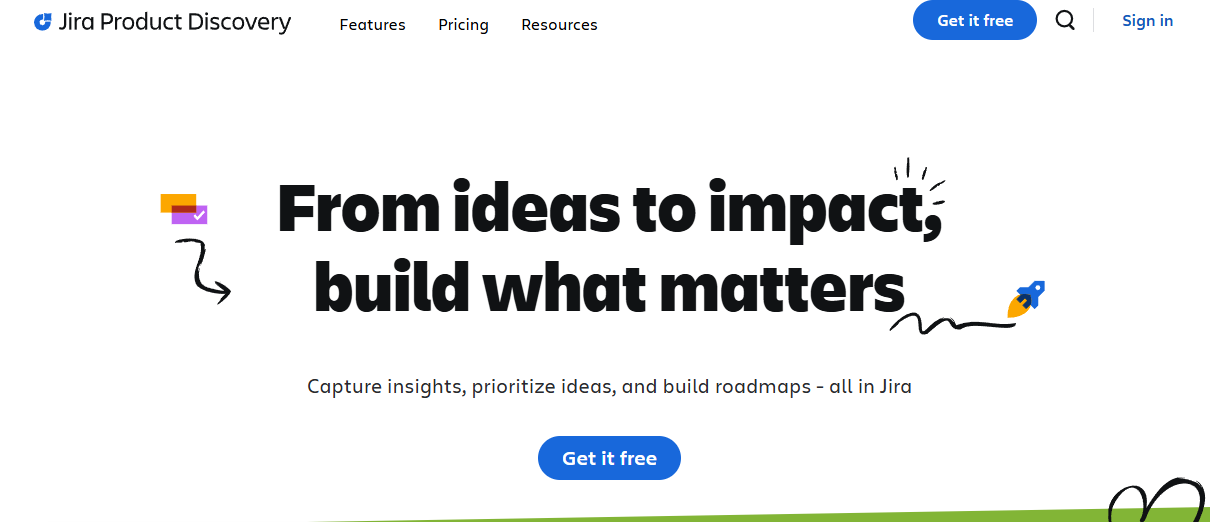
Jira Product Discovery helps product teams capture and prioritize ideas while tying them directly into delivery pipelines. It’s designed to bring visibility and structure to product thinking inside companies already using the Jira ecosystem.
This tool is great for:
Capturing product ideas and hypotheses from cross-functional teams
Organizing and scoring opportunities with prioritization matrices
Connecting discovery insights to Jira delivery tickets
Keeping stakeholders aligned on what's being considered, explored, or built
Creating a living product roadmap that evolves with user feedback
2. Productboard

Productboard centralizes customer insights and connects them to product strategy. It helps you prioritize features based on real user needs and internal business goals, making it easier to build what matters most.
This tool is great for:
Aggregating feedback from support tickets, sales calls, and surveys
Prioritizing features based on customer segments and product goals
Creating public or internal product roadmaps
Communicating product direction to stakeholders
Validating product decisions with a traceable insight history
3. Typeform

Typeform helps teams collect user input through conversational surveys. Its intuitive, user-friendly format improves response rates and enables discovery research without needing a dedicated research team.
This tool is great for:
Running product-market fit and UX surveys
Gathering user sentiment around early product concepts
Validating hypotheses quickly with target audiences
Personalizing questions with logic branching
Embedding discovery surveys into emails, websites, or landing pages
4. Maze

Maze empowers teams to test prototypes, concepts, and messaging with real users—all without writing code. It’s built for fast feedback and continuous discovery and works seamlessly with tools like Figma and InVision.
This tool is great for:
Remote unmoderated usability testing
Running A/B tests on feature concepts
Collecting behavioral data from prototype interactions
Measuring usability metrics like time-on-task and success rate
Validating product-market fit before development begins
5. Miro

Miro is a collaborative visual workspace ideal for real-time and asynchronous teamwork. Product teams rely on it to synthesize research, facilitate ideation sessions, and visually map user journeys and discovery paths.
This tool is great for:
Running remote discovery workshops and design sprints
Mapping user journeys, storyboards, and empathy maps
Affinity diagramming to synthesize user interviews
Collaborating with stakeholders on prioritization grids or OKRs
Documenting discovery outcomes for handoff to development teams
6. Dovetail
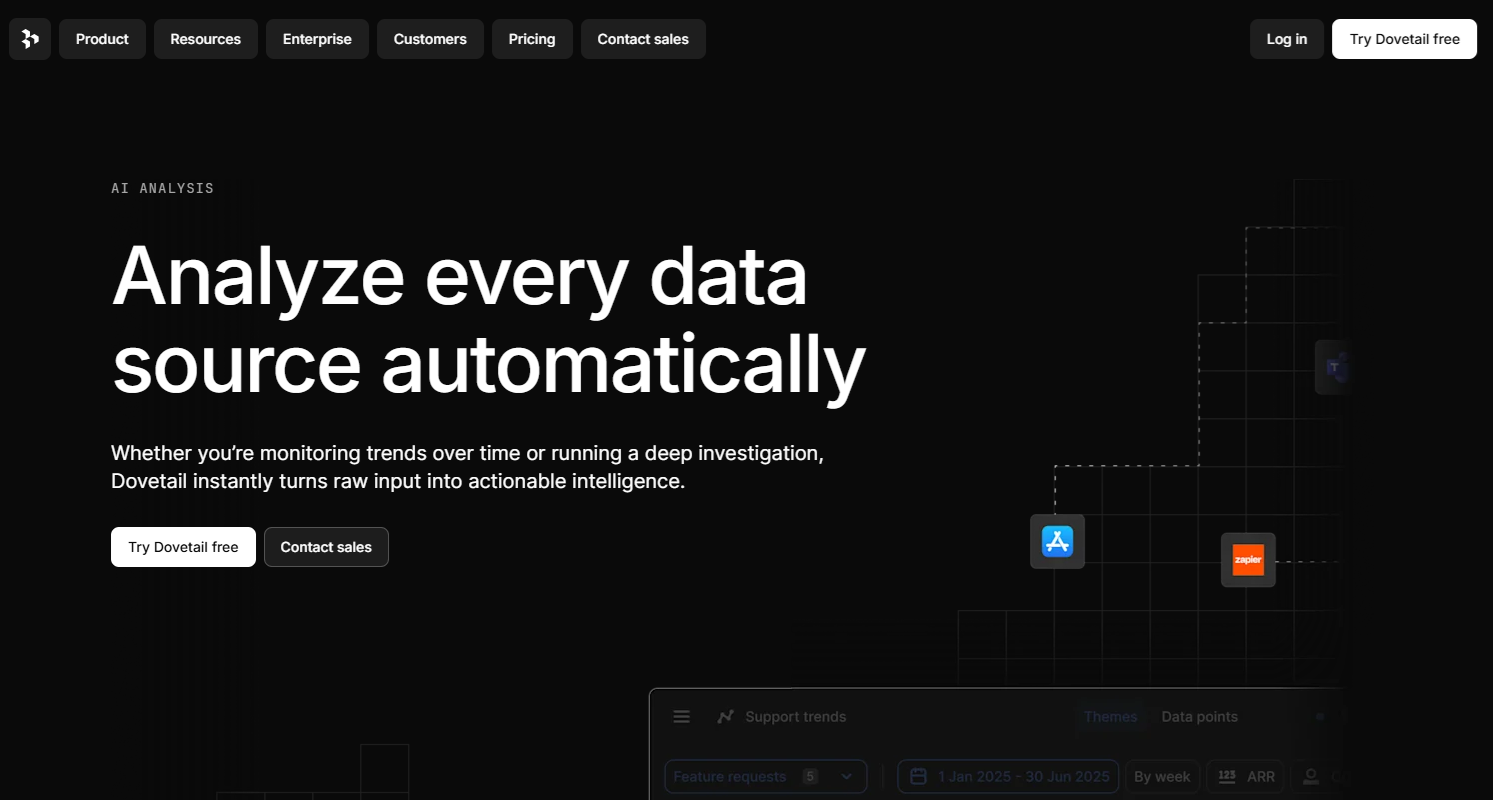
Dovetail is a qualitative research repository that helps teams organize and synthesize interview notes, user quotes, and usability data into actionable insights. It’s designed to centralize research efforts and make findings easily searchable and shareable.
This tool is great for:
Analyzing and tagging user research transcripts for recurring patterns
Creating highlight reels of quotes to present findings to stakeholders
Organizing insights across multiple studies and teams
Building a searchable database of user feedback and discovery data
Keeping research accessible and usable across sprints and teams
7. Figma

Figma is a collaborative design tool that supports product discovery through rapid prototyping, real-time feedback, and cross-functional ideation. It’s especially valuable in early-stage design and validation.
This tool is great for:
Building interactive prototypes without writing code
Collaborating with designers, developers, and stakeholders in real time
Annotating design concepts with hypotheses and assumptions
Running lightweight user tests and concept walkthroughs
Maintaining a single source of truth across product iterations
Frequently asked questions
Get answers to important FAQs.
How long does product discovery usually take?
The timeline depends on your product complexity and team size, but most discovery phases range from 2 to 6 weeks. For early-stage startups or MVPs, it may be shorter. For enterprise-level software or legacy modernization, it can extend longer. The goal is to balance thorough research with enough speed to maintain momentum in development.
Can I skip product discovery if I already have a clear product idea?
Even with a strong vision, skipping discovery is risky. You may still uncover unexpected user needs, technical constraints, or market insights that change your execution. Teams that bypass discovery often end up revisiting it later after costly missteps.
What deliverables should come out of a discovery phase?
Key deliverables include user personas, journey maps, validated problem statements, prioritized feature lists, low-fidelity prototypes, and early user feedback. Some teams also document key research insights, technical considerations, and product hypotheses. These assets act as a bridge between strategy and development.
Do I need to include engineers in product discovery?
Yes. Involving engineers early avoids costly surprises later. Developers provide valuable technical context and feasibility checks during ideation, which helps prevent solutions that are difficult, expensive, or impossible to implement. Including them also speeds up the transition from discovery to delivery.
How does product discovery fit into an agile development process?
Product discovery complements agile by feeding prioritized, user-validated ideas into the backlog. With dual-track agile, discovery and delivery happen in parallel. While one team builds, another explores and validates what to build next. This continuous loop keeps your roadmap aligned with real user needs and market changes.
Our high-performing teams handle your entire SaaS product design and development process, including product discovery. Check out our software product discovery process to see how we can help you build your dream SaaS product.

Tobi Moyela