
Recruiting the right people can be time-consuming and complex. Especially for tech roles - where you need a thorough understanding of what the job entails and what experience is necessary - the process can be a little overwhelming.
However, in the modern age, developers are a core addition to any team, as nearly every company needs developers to build, maintain, and iterate websites, apps, databases, and software.
In fact, predictions state that software developer employment is projected to grow 15 percent from 2024 to 2034 - much faster than the average growth for other occupations. This increase means that while there is a large pool of developer candidates, they are equally in high demand. On top of that, almost nine in ten HR professionals say that they find it 'challenging' to hire technical talent, while over a third find it 'very challenging'.
From roles, responsibilities, and general tips, here's a step-by-step guide on everything you need to know to better navigate the hiring journey for developers:
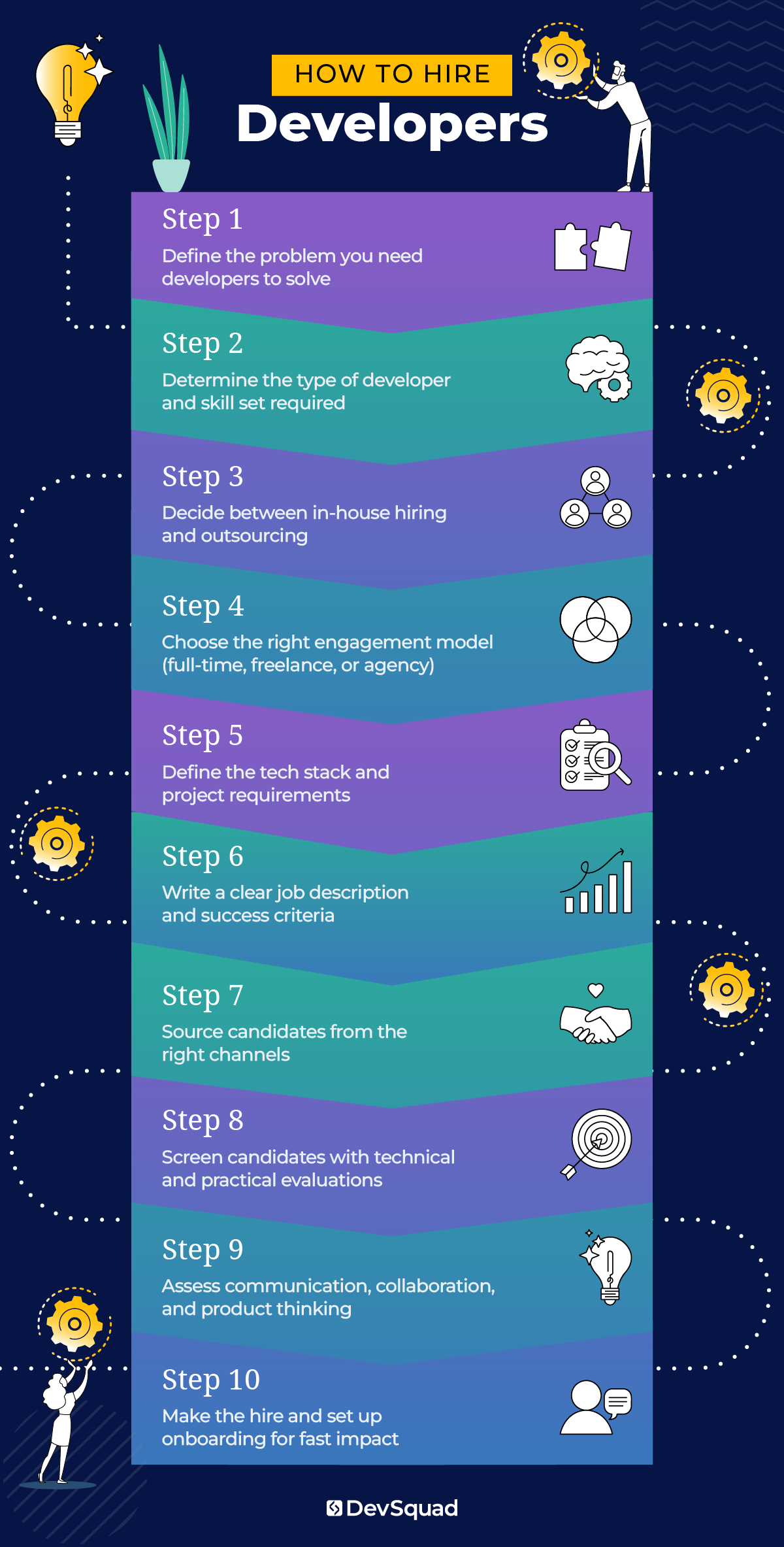
Step 1. Define the problem you need developers to solve
Before you think about how to hire developers, you need to get clear on one thing: what problem you’re actually trying to solve.
Hiring developers without a defined problem leads to wasted time, bloated teams, and software that doesn’t deliver value. The goal of hiring is to solve a business problem with the right technical approach.
Start with the business objective
Every hiring decision should tie back to a clear outcome. Ask:
Are you building a new product or improving an existing one?
Are you trying to increase revenue, reduce costs, or improve efficiency?
Is this a short-term initiative or a long-term product investment?
If you can’t clearly define the objective, you’re not ready to hire dedicated developers or bring on any development support.
Identify the specific problem
Move from broad goals to a clearly defined problem.
What is currently not working?
Where are users experiencing friction?
What processes are slowing your team down?
What opportunity are you missing in the market?
The more specific you get, the easier it becomes to create a roadmap to hiring software developers that actually fits your needs.
Define the scope of the solution
Once the problem is clear, outline what kind of solution is required.
Are you building a web app, mobile app, or internal tool?
Do you need ongoing development or a one-time project?
Will this require integrations, data migration, or system modernization?
This step directly impacts whether you hire freelance developers, build an in-house team, or partner with an external development firm.
Align stakeholders early
One of the biggest mistakes companies make is moving forward without alignment.
Do business and technical teams agree on the problem?
Is leadership aligned on priorities and budget?
Are expectations realistic in terms of timeline and outcomes?
Misalignment at this stage creates downstream issues in hiring, development, and delivery.
Why this step matters
If you skip this step, every decision that follows becomes harder:
You won’t know where to hire developers or what to look for
You risk hiring the wrong skill sets
You’ll struggle to evaluate candidates effectively
Your development process will lack direction
When done correctly, this step gives you a clear foundation for every next decision—from choosing the right engagement model to building a high-performing team.
Step 2. Determine the type of developer and skill set required
Just like the technology they work with, developer roles are always evolving. As new needs emerge, so do developer specialities and skill sets.
Choosing the right type of developer is one of the most important decisions in your roadmap to hiring software developers. The role you choose should directly reflect the problem you defined in Step 1.
Below are some of the common types of developers and the languages they typically should know.
Front-end developer
These developers focus on the visuals of UI (user interface), meaning they write the code that implements the formats and styles of platforms.
Front-end devs are typically expected to know programming languages like:
JavaScript
HTML
CSS
Back-end developer
These developers concentrate on functionality and are responsible for server-side web application logic. They integrate the work front-end developers do and power the components together to effectively run the platform.
Back-end developers tend to know programming languages such as:
PHP
Ruby
C++
C
Python
Perl
Full-stack developer
These developers are essentially a mix of front and back-end. They develop both the client and server side of software, so can tackle projects that involve databases or build user-facing websites.
Full-stack developers often work in more than one programming language, ranging from:
HTML
CSS
JavaScript
Ruby
PHP
Python
Mobile app developer
These developers write code for devices like apps, tablets, and wearables. They typically work in teams and generate concepts for specific user needs.
Mobile app developers work in either Android or iOS, with programming languages such as:
C
C++
JavaScript
Android Studio
Swift
Objective-C
Software developers
These developers make the foundations for operative systems by designing each piece of it and putting them together. They use knowledge of engineering principles to also design, test, and develop software, as well as recommend upgrades.
Required programming languages for this role include:
Java
Python
C++
Scala
Security developers
These developers establish frameworks and techniques to confirm the security of a site or application, along with checking for potential vulnerabilities.
They use programming languages like:
Python
Ruby
C
C++
How to know what type of developer to hire
Technical co-founders or CTOs should be responsible for hiring developers, as they can pinpoint the exact project needs and align these with their search. Experts say that "you need someone technical who is mature enough and has built enough technology to know that it’s not easy."
If you're not a technical founder, the first action you have to take is to decide what tech stack you'll be using to create the software or platform. This will determine the programming language you'll need devs to be well-versed in.
Then, think about:
Whether your product will be primarily on mobile or web
What servers will be hosting your back-end
What other technological tools will be at play
How many developers you would need to scale, and in what timeframe
These details should give you a solid foundation to move forward with hiring.
While it's easy to trust the word of one person, be cautious to get input from multiple people around what developer type you need and why.
Why this step matters
Getting this step right directly impacts:
How to hire developers with the right expertise
Where to hire developers based on specialization
Whether you should hire freelance developers or hire dedicated developers
If you misidentify the role, even highly skilled developers won’t be able to deliver the outcome you need.
Step 3. Decide between in-house hiring and outsourcing
Now that you’ve defined the problem and determined the type of developer you need, the next decision is where your development team should live.
This is one of the most important decisions in your roadmap to hiring software developers because it impacts cost, speed, control, and long-term scalability.
At a high level, you’re choosing between building an internal team or working with external partners. This decision is separate from whether you hire full-time, freelance, or through an agency—that comes in the next step.
Before diving into the options, it’s important to understand the tradeoffs:
In-house teams offer more control and alignment
Outsourced teams offer more flexibility and faster hiring
Each model affects how you collaborate, scale, and manage development
In-house developer
In-house developers are hired by your organization and work as part of your team.
This model works best when you’re building a long-term product, need tight collaboration, or want developers deeply embedded in your company’s processes and culture.
Pros
Greater collaboration and communication
In-person contact (can walk to their desk and brainstorm)
Up-to-speed on projects faster
Better transparency and tracking
More invested in the company and project (therefore more loyal)
Cons
More expensive (extras like taxes, software, hardware, overhead costs, training, sick days, and benefits)
Longer search to find and recruit people
Harder to replace if the developer leaves
Outsourced developer
Outsourced developers are hired from an external company and potentially work for multiple teams.
This model works best when you need to move quickly, access specialized skill sets, or avoid the overhead of building an internal team. It’s also a common path for companies looking to hire freelance developers or hire dedicated developers through a partner.
Pros
Cheaper salaries
Good to build a network of connections and engage different skill sets
Faster hiring process
Cons
Lack of control and limited code collaboration
Logistical challenges
Potential lower work quality
Possibility of compromising work culture (in-house employees may fear they are being replaced)
Choosing between these two options will shape how you approach hiring, collaboration, and delivery.
Once you’ve made this decision, the next step is to determine the right engagement model for your team.
Step 4. Choose the right engagement model (full-time, freelance, or agency)
Once you’ve decided between in-house hiring and outsourcing, the next step is to determine how you want to engage developers.
This decision defines how work gets done, how teams communicate, and how quickly you can move. It’s a critical part of your roadmap to hiring software developers because the wrong engagement model can slow progress—even if you hire the right people.
At a high level, there are three common ways to hire developers:
Full-time employees
Freelance developers
Dedicated development teams or agencies
Each model has different strengths depending on your goals, timeline, and internal capabilities.
Full-time developers
Full-time developers are permanent employees who work exclusively on your product.
This model works best when:
You’re building a long-term product
You need consistent development and iteration
You want deep alignment with your business and users
Full-time hiring gives you the most control, but it also requires the most time and investment. It’s typically the right choice once your product and roadmap are well-defined.
Freelance developers
Freelancers are independent contractors hired to complete specific tasks or short-term projects.
This model works best when:
You need help with a clearly defined task or feature
You want to move quickly without long-term commitments
You’re filling short-term gaps in your team
Many companies choose to hire freelance developers for flexibility and cost savings. However, freelancers often require more hands-on management and may not be as invested in long-term product success.
If you’re exploring how to hire developers quickly, freelancers are often the fastest option—but not always the most scalable.
Dedicated developers or development teams
Dedicated developers are part of an external team that works consistently on your product, often through an agency or development partner.
This model works best when:
You need a full team (developers, product managers, QA)
You want to move fast without building an internal team
You need ongoing development with strategic guidance
Companies that hire dedicated developers gain access to established processes, experienced teams, and faster onboarding. This approach combines the consistency of in-house teams with the flexibility of outsourcing.
It’s also one of the most effective options if you’re unsure where to hire developers with the right mix of technical and product expertise.
How to choose the right model
To determine the best fit, consider:
Project scope: Is this a one-time build or an ongoing product?
Internal expertise: Do you have leadership to manage developers?
Speed: How quickly do you need to start and deliver?
Budget: Are you optimizing for short-term cost or long-term value?
There’s no one-size-fits-all approach. Many companies use a combination—for example, a core team of full-time developers supported by freelancers or an external partner.
The engagement model sets the foundation for how your team operates.
Next, you’ll define the technical requirements and scope that guide what your developers actually build.
Step 5. Define the tech stack and project requirements
Before you hire developers, you need to clearly define what they’re building.
Without a defined scope, even the best developers will struggle to deliver results. This is where many companies fail in their roadmap to hiring software developers—they start hiring before they’ve clarified the work.
This step turns your initial idea into something developers can actually execute.
Define the core features and functionality
Start by outlining what your product or system needs to do.
What are the must-have features for launch?
What can wait until later iterations?
What are the key user flows?
Avoid trying to build everything at once. Focus on the core functionality that solves your primary problem.
This clarity makes it easier to:
Hire developers with the right experience
Estimate timelines and costs
Avoid scope creep during development
Choose the right tech stack
If you're not a technical founder, the first action you have to take is to decide what tech stack you'll be using to create the software or platform. This will determine the programming language you'll need devs to be well-versed in.
Then, think about:
Whether your product will be primarily on mobile or web
What servers will be hosting your back-end
What other technological tools will be at play
The tech stack should support your long-term goals—not just short-term convenience.
How to approach this if you're not a technical founder
If you're not a technical founder, choosing the right tech stack and defining project requirements can feel overwhelming—and it’s easy to make the wrong decisions early.
In many cases, this is where projects go off track. Founders either:
Choose technologies based on trends instead of long-term fit
Rely on a single developer’s opinion without validation
Or skip proper planning and move straight into development
A better approach is to bring in experienced guidance before you hire developers.
This could include:
A technical advisor or CTO-level consultant
A product strategist who can translate business goals into technical requirements
A development partner who can help define the architecture and roadmap
Getting this right upfront will make every step that follows easier—from how to hire developers to where to hire developers with the right expertise.
Estimate team size and timeline
Lastly, estimate how many developers you would need to scale, and in what timeframe.
Consider:
How complex is the product?
How quickly do you need to launch?
Will development be ongoing after launch?
This helps you decide whether to:
Hire freelance developers for short-term work
Hire dedicated developers for ongoing development
Build a larger, long-term team
This step connects your hiring decisions to actual execution.
Without this clarity, hiring becomes guesswork—and development becomes inefficient.
Step 6. Write a clear job description and success criteria
Once you’ve defined the scope and technical direction, the next step is to clearly define the role you’re hiring for.
A strong job description helps you hire developers faster, evaluate candidates more effectively, and set clear expectations from day one.
Core developer responsibilities
Developer responsibilities change according to the different roles, however, there are some core tasks that all developers own.
Developers are expected to:
Research, design, implement, and manage software programs
Test and evaluate new programs
Write and implement efficient code
Develop quality assurance procedures
Train users
Work alongside other developers, UX designers, and business/systems analysts
What to include in your job description
With these in mind, make sure you tailor your job description towards such responsibilities, explicitly referring to the areas that your new hire will target.
Your job description should include:
A brief overview of the role
An introduction to your company
Preferred programming languages and years of experience
Certifications that give applicants an advantage
Optional sections can include:
Benefits offered
Growth opportunities
Salary range
When drafting the job description, try to integrate your company culture into it - carry your tone of voice, your values, mission, and be clear about the level of autonomy developers are given in your business.
Define success criteria for the role
Before you hire developers, you should be clear on what success looks like.
What should this developer accomplish in the first 30, 60, and 90 days?
What outcomes are they responsible for delivering?
How will you measure progress and performance?
Clear success criteria make it easier to:
Evaluate candidates during the hiring process
Align expectations after hiring
Keep development work focused on business outcomes
Step 7. Source candidates from the right channels
Once you’ve defined the role and expectations, the next step is deciding where to hire developers.
Finding the right candidates isn’t just about volume—it’s about targeting the right platforms based on your needs, budget, and hiring model.
Where to hire developers
Whether you decide to hire in-house or outsource, it's recommended to devote a good amount of time researching potential candidates.
You can use recruitment platforms like:
These platforms allow you to browse availability, cost, and experience across a wide range of developers.
How to choose the right sourcing channel
Different channels serve different purposes. Your choice should align with how you plan to hire developers.
Freelance platforms (e.g., Upwork, Toptal): Best if you want to hire freelance developers for short-term or project-based work
Professional networks (e.g., LinkedIn, Hired): Ideal for sourcing full-time candidates or building a long-term team
Agencies and development partners: Useful if you want to hire dedicated developers or full teams with established processes
Tips for sourcing better candidates
To improve your results when sourcing candidates:
Focus on platforms that match your hiring model
Compare candidates based on experience, not just cost
Look for relevant project experience and technical depth
Be clear about your requirements before reaching out
Taking the time to research and source properly will make the rest of the hiring process much more efficient.
Step 8. Screen candidates with technical and practical evaluations
Once you’ve sourced candidates, the next step is to evaluate their technical ability and problem-solving skills.
Likewise, ensure that you have a comprehensive technical test ready to judge how well developers perform before offering them a position. For this part, DevSkiller is a great platform dedicated to developer screening that tests a range of programming languages, frameworks and libraries.
Use technical tests to validate skills
A structured technical assessment helps you objectively evaluate candidates.
Use real-world coding challenges when possible
Test relevant programming languages and frameworks
Focus on how candidates approach problems—not just final answers
This step is essential when figuring out how to hire developers who can actually deliver in a production environment.
Ask questions that reveal problem-solving ability
Development is all about problem-solving, so when it comes to sitting opposite your candidate, you should hone in on questions that provoke critical thinking and justifications for the answers given.
A few particularly powerful and revealing questions for developers are:
'What programming languages do you use and which do you prefer?'
'Pretend I know nothing about tech. Tell me in simple English what {insert tech feature} is and how to use it.'
'Can you describe a time to me when you developed a feature and once it was delivered, it wasn’t what the client wanted? Can you identify where the disconnect was, and what exactly you learned from the experience?'
'Give me an example of when a team member was struggling and you proactively helped. What steps did you take and what was the different outcome?'
'What do you do when an application/platform stops working?'
'What skill are you hoping to learn this year?'
'How comfortable are you working with non-tech team members?'
'What APIs have you worked with?'
'Can you find the error in this code?' (Any small, practical test to be completed in front of you)
In the end, screening candidates effectively helps you build a stronger, more capable development team.
Step 9. Assess communication, collaboration, and product thinking
Technical skills are critical, but they’re not enough on their own.
A 'one size fits all' approach won't work with developers — you need to tailor your messaging and whole hiring attitude based on the role you're looking for and the expertise you want.
Evaluate communication skills
On the flip side, you should be cautious to monitor how well your applicants communicate. Even though developers are computer and tech-oriented roles, if they have poor conversation abilities, that's a red flag.
Look for developers who can:
Explain technical concepts clearly
Communicate effectively with non-technical team members
Ask thoughtful questions about requirements
Strong communication is essential for avoiding misunderstandings and keeping projects on track.
Look for collaboration and team fit
Developers rarely work in isolation.
They need to collaborate with:
Other developers
UX designers
Product managers
Business stakeholders
During the hiring process, pay attention to how candidates:
Talk about past team experiences
Handle feedback and challenges
Contribute to group problem-solving
This way you can be more confident that your developers will not only write code, but be able to contribute to better products.
Step 10. Make the hire and set up onboarding for fast impact
After evaluating candidates and selecting the right fit, the final step is to make the hire and create an environment where developers can succeed.
Hiring developers isn’t just about filling a role—it’s about building a long-term, productive relationship.
Make a compelling offer
Keep in mind that developers are highly focused on growth and long-term opportunities. In fact, recent research shows that career advancement and keeping up with new technologies are their top priorities—and that 40% of developers plan to leave their current company within a year if those needs aren’t met.
Position your company as a place developers want to work
To demonstrate that you promote professional development, establish yourself as a thought-leader by publishing engaging, insightful content on your blog and social media platforms.
You could also:
Host hackathons
Run virtual events
Create conversations around industry trends
These efforts help you stay on top of new trends and create a general buzz about your company.
Set expectations for long-term success
Although recruitment can be taxing, understanding what developers do and how best to attract them is crucial to bringing on board the best people.
Moreover, having a clear idea of what your requirements and expectations are will allow you to match developers accordingly and build a long-term, successful relationship with them.
Learn more about how DevSquad can expand your dev team, no hiring required.

Dayana Mayfield is a SaaS copywriter and content marketer specializing in SaaS marketing, positioning, and go-to-market strategy. She has consulted for over 195 SaaS companies, focusing on both traffic and conversions. She has been featured in Entrepreneur, Forbes, and Business Insider. Outside of work, Dayana writes SciFi novels and spends her evenings surviving auditions, rehearsals, and tech week as a proud theater mom.