
You don’t have to hit the billionaire club to have a successful, highly profitable SaaS product. SaaS companies in the $7.5M to $15M range are the fastest growing subset. And with its higher prices and more willing customers, B2B SaaS is where you want to innovate.
In this post, learn what B2B markets need SaaS solutions, and how to create messaging to market and sell your product.
Table of contents:
What is B2B SaaS
Why B2B SaaS is a better opportunity than B2C SaaS
B2B SaaSmarket size and growth
Top B2B SaaS companies
B2B SaaS markets with untapped potential
B2B SaaS pricing
B2B SaaS marketing
B2B SaaS sales
B2B SaaS GTM strategy
FAQs
What is B2B SaaS?
B2B SaaS is software that is sold as a service to businesses, not consumers. We are all quite familiar with what SaaS is these days. But just to make sure we're all on the same page it’s a software that you access in a web browser, mobile app, or desktop app from any device, anywhere.
The primary tenet of the SaaS industry is that products and services are accessible via the cloud. SaaS products are also expected to be easier to use and better designed than traditional, old school software products.
And remember: B2B means business to business. So B2B SaaS is a product that is sold to businesses.
A consumer SaaS product could be an app for storing and sharing photos with close family members. Meanwhile, a B2B SaaS example would be a software platform for storing and sharing photo, video, audio, and document files within a company.

Why B2B SaaS is a better opportunity than B2C SaaS
When marketers, SaaS influencers, and entrepreneurs talk about SaaS, they’re almost always referring to B2B SaaS—and for good reason. In the comparison of B2B SaaS vs. B2C SaaS, it’s clear that the benefits of B2B SaaS include more stability, higher customer lifetime value, and a greater opportunity for scalable growth.
B2C SaaS products target consumers who..
Make emotional or impulsive purchases.
Prioritize visually appealing designs, flashy deals, and frictionless experiences
Are the most likely to churn.
Conditioned to expect free apps and resist any kind of paywall or subscription fee
In contrast, B2B SaaS products solve real business problems. Companies are willing to pay for tools that reduce costs, streamline workflows, improve productivity, or increase revenue. Business buyers are less influenced by aesthetics (don’t mistake that with great UX though) or emotion and more focused on measurable ROI.
The best B2B SaaS companies win by deeply understanding their customers’ operational pain points—and then building solutions that directly address them. When your product helps a company save time or scale more effectively, they stick around, pay more, and even advocate for your tool within their industry.
B2B SaaS market size and growth
The SaaS market continues to out pace projections. For instance, the USD 307 billion by 2026 market projection has been replaced by $390 billion in 2025.
There are three major SaaS market trends influencing this outstanding growth:
Artificial intelligence is increasingly making its way into mainstream B2B SaaS, offering competitive advantages in areas like automation, decision support, and personalization. While AI isn’t yet a core expectation across the board, it’s quickly evolving and driving heavy growth.
Smartphones, laptops, and tablets are now essential business tools for employees at every level. Staying connected and up to date is the norm, making cloud-based software a requirement. This fundamental shift continues to drive steady demand for flexible, cloud-native solutions.
Front-line and traditional industries—like real estate, construction, logistics, and insurance—are embracing vertical SaaS: specialized platforms designed to serve their unique needs. These tools offer industry-specific workflows, compliance features, and integrations that general-purpose software can’t match.
Top B2B SaaS companies
In our list of top SaaS companies, we include plenty of B2B case studies, including large and small companies.
Here are some example B2B SaaS examples across a few different categories:
Market leaders
Fast-growing B2B SaaS companies
Micro-SaaS companies
All-in-one niche platforms
Market leaders

Market-leading companies capture the most amount of market share and are often well known brands among professionals.
Here are some example market-leading B2B SaaS companies:
Salesforce. As the largest B2B SaaS company in the U.S., Salesforce projects an astonishing $40 billion in revenue by 2026. Known for CRM and marketing automation, it helps enterprise teams improve customer support and retention. Its growing AI suite—including Agentforce—aims to boost productivity with generative AI-powered customer service agents.
Hubspot. Hubspot offers a B2B SaaS platform for sales, marketing, CRM, and customer service. It is considered a leader in enterprise-level marketing automation, web content management, customer success, and social media management. It also offers certifications in content marketing, digital marketing, inbound marketing, and related skills for people in the industry that make it a go-to web destination.
Adobe. Adobe markets itself as a digital platform for creative, marketing, and document management. But there is no chance you don't already know what Adobe is, because it's the default platform for PDF files, having invented them.
ServiceNow. A global leader in digital workflow automation, ServiceNow helps enterprises manage IT operations, employee services, and customer experiences. Its cloud-based platform streamlines tasks across departments, driving efficiency at scale. With continued innovation in AI and low-code tools, ServiceNow remains a top B2B SaaS provider for complex, enterprise-level needs.
OpenAI. OpenAI has rapidly become a dominant B2B SaaS force by delivering AI infrastructure to businesses through products like ChatGPT and enterprise APIs. With widespread adoption across industries, OpenAI enables companies to build intelligent tools, automate workflows, and enhance productivity—positioning itself as a core layer in the modern SaaS ecosystem.
Fast-growing B2B SaaS companies

Fast-growing companies seem to come out of nowhere, attracting hoards of new customers and capturing tons of market share, despite there already being well-established competitors available. Here are metrics from some of the fastest-growing B2B SaaS businesses in 2021.
ClickUp. Asana and Trello didn’t see ClickUp coming. Known for its sleek UX and powerful automation, ClickUp has scaled rapidly through word-of-mouth. Since launching in 2016, it’s grown to $278.5 million in revenue by 2024—up 75.4% from the previous year—solidifying its place among fast-growing B2B SaaS companies.
InVideo. InVideo is a fast-growing SaaS platform that helps businesses create videos using customizable templates and a vast media library. With over 7 million users producing hundreds of thousands of videos each month, the company has attracted major investor interest
Abacus AI. Abacus AI delivers end-to-end tools for building, deploying, and managing AI models—no deep data science expertise required. Its fully managed platform automates deep learning workflows, helping enterprises and developers integrate AI faster. With 99x+ search growth over five years, Abacus AI is firmly in the exploding B2B SaaS category.
Micro SaaS companies

Smaller software companies solve small, yet still persistent, problems. Here are some B2B examples of micro-SaaS companies:
UTM.io. As for an example of a micro SaaS, UTM.io is an affordable SaaS product used by marketers who want to track their UTM codes in a more usable way, instead of relying on messy spreadsheets.
Storemapper. With Storemapper, Shopify-powered e-commerce merchants can include a map on their website that helps shoppers locate physical store locations.
Snipply. Tired of pasting the same snippets into your docs, emails, or code? Snipply is a simple tool that lets marketers, support reps, and developers save and reuse text snippets—no more digging through old files or messages.
All-in-one platforms for niche business verticals

A vertical SaaS is one that satisfies the needs of one particular type of business. This niche platforms typically offer "all-in-one" so that small business owners don't have to piece together lots of different SaaS products.
DesignFiles. A platform for interior designers, DesignFiles provides design tools like mood boards and 3D renderings alongside client collaboration and invoicing.
HoneyBook. A popular platform among photographers, HoneyBook lets creative entrepreneurs sell packages, get contracts signed, and manage their schedules.
Propertybase. Propertybase is an all-in-one platform that real estate agents use for their CRM, back office operations, website management, and lead capture and nurturing.

B2B SaaS markets with untapped potential
You don’t have to chase the hottest trends to find a winning B2B SaaS idea. With more industries undergoing digital transformation, even highly specific markets are now large enough to support seven- and eight-figure businesses. In fact, niche often beats broad—especially when you can solve a real pain point better than anyone else.
Here are several opportunities worth exploring.
Internal tools that escape the spreadsheet
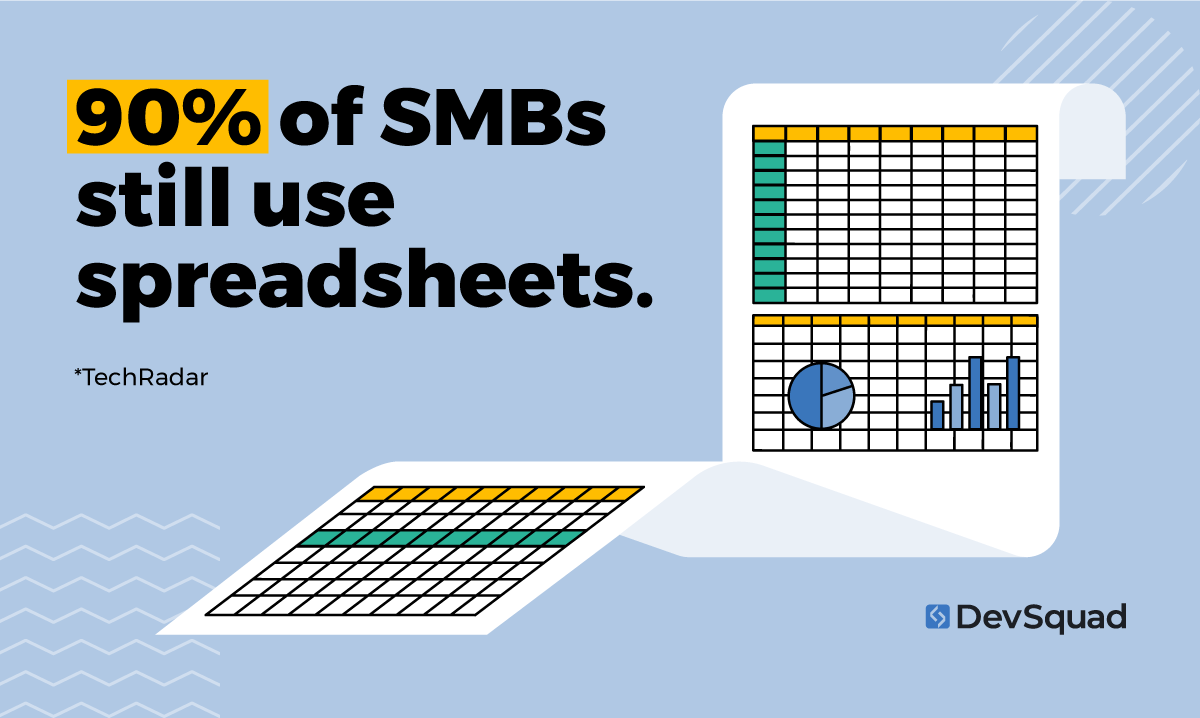
Nearly 90% of small and mid-sized businesses still rely on spreadsheets to track critical operations—everything from job applicants to facility repairs. While enterprise software exists, it’s often too expensive or complex. There's growing demand for lightweight tools that replace manual tracking with automated, purpose-built workflows.
Here is where industry specific B2B SaaS application can really stand out as well. There may be norms to how businesses manage those spreadsheets. They may have transferred from trade school, or carried over when someone decided to branch out on their own. This is where the best solutions exist.
Think: internal help desks, license and vendor management, or feedback loops that don’t get lost in Slack.
Certification and compliance tracking
Across industries, compliance is becoming more complex—and more costly to manage manually. Many teams are still juggling emails and PDFs to stay current on certifications, safety checks, or audits. Whether it’s HIPAA, OSHA, or internal policy training, the right software can turn a recurring pain into a predictable workflow.
This is a strong fit for many vertical SaaS categories—especially in industries like healthcare, logistics, and education.
Tools for solopreneurs who do it all
Freelancers, creators, and consultants are underserved by bloated business tools. That’s around 10 million people in the US alone ready to take advantage of tools that support their workflow. While the numbers aren't staggering, these are the people ready to jump on solutions that tackle their pain points.
They need simple, flexible software to help with proposals, onboarding, invoicing, and client communication. The market is especially ripe for tools that offer “just enough” structure—without assuming the user has a team.
With the right pricing model and UX, these micro SaaS ideas can grow fast, with minimal overhead, and a dedicated user base that wants to focus on what they do best.
Community organizations and local services
From parks departments to small nonprofits, many local organizations still manage operations with outdated tools—or none at all. These groups often need help with event planning, volunteer coordination, maintenance tracking, or donation management. The budgets may be modest, but the problems are real—and widespread.
If you can design for ease of use and quick wins, this is a market that talks, shares, and advocates for tools that work. This one's a numbers game, but your impact goes beyond the problem you're solving and supports the solutions these organizations provide for the people.
Specialized HR for flexible workforces
Not every company runs on 9-to-5 schedules. Gyms, restaurants, salons, and seasonal teams need scheduling, HR, and people ops tools that reflect how their work actually gets done. Big-name HRIS platforms don’t serve them well, creating space for leaner tools that are mobile-first and shift-friendly.
This is a category where strong UX and fast setup beat feature depth.
Do you already have a plan for a new business? Use this process to vet your SaaS idea before you build.
B2B SaaS pricing
The other thing that makes B2B SaaS different from consumer-focused products is what you can charge.
While consumers aren’t likely to pay more than the cost of a fancy latte for a monthly subscription to any app, businesses will pay based on the value they receive from the product.
For example, if you help a business save 100 administrative hours per month calculated at $25 per hour, you’re saving them $2500 per month. And their administrators are freed up to work on more important projects. That business might be willing to pay $750 or more per month for your product, because for them, it’s still a cost savings.
There are so many factors that go into pricing a B2B SaaS product. While the average SaaS company spends just 6 hours creating their pricing strategy, experts recommend that you revisit and update it regularly.
Survey responses and other qualitative data on the amount businesses will pay for your product
What your direct competitors are charging
What your indirect competitors are charging for either more robust or less comprehensive software products
Average revenue of the customer base according to business models
How much money your SaaS product helps your customer make or save
How much time your SaaS product saves your customer and/or their staff
SaaS pricing models
Most SaaS products are offered at flat-rate subscription tiers, but that’s just one option. With the rise of AI and trying to better match demand with cost, pricing strategy has become a serious growth lever.
Here are some of the most common SaaS pricing models:
Flat-rate pricing: A single price for all features, best for tools with consistent usage and simple value delivery.
Tiered pricing: Multiple plans with increasing features or limits, ideal for upselling and scaling with customer needs.
Per-user pricing: Charges based on the number of users, common for collaboration tools and internal platforms.
Usage-based pricing (pay-as-you-go): Customers pay for what they use, great for APIs, data platforms, or storage tools.
Hybrid pricing: A mix of flat fees, tiers, or usage charges, offering flexibility for diverse customer segments.
Value-based pricing: Price reflects the measurable impact of your product (like time saved or revenue generated).
While subscription-based models still lead the way, usage- and value-based pricing are growing fast. The best pricing strategy is the one that aligns with how your customers experience value—and evolves alongside your product.
Make sure to take the time to find which SaaS pricing model is right for your product.
B2B SaaS marketing
Marketing a B2B SaaS product is also very different than marketing a consumer product. While some B2B SaaS companies can succeed with social media, particularly on niche social networks, most will have greater success using these proven B2B marketing methods:
Direct mail: You might not think that B2B SaaS companies can succeed with direct mail, but many do. Brightwheel sends direct mail letters (not postcards) to daycare and preschool owners.
SEO optimization: Getting organic search traffic is a favorite marketing strategy by nearly all B2B SaaS companies, who want to decrease their dependence on ads. Companies usually aim to SEO optimize their web pages and blog posts.
Google search advertising: While most B2B SaaS companies fail with Facebook ads, they usually win with Google search ads, because you can target people who are searching for your exact solution or relevant search queries.
LinkedIn advertising: In the B2B world, LinkedIn offers the best ways to target the customers you’re looking for.
Gated content: Whether a company has an internal sales team or sells only from their website, gated content like webinars and downloadable guides are always a smart way to convert traffic into leads.
Email marketing: Creating a high-value email newsletter can help B2B SaaS companies stay top of mind with potential customers.
The price point of your Saas product will greatly affect the marketing channels you use. For higher priced SaaS, you can afford an inside sales team to manage cold emailing and cold calling. For lower priced SaaS, you’ll likely want to invest in marketing that scales more rapidly, such as Google search ads and organic SEO.
B2B SaaS sales
Because B2B SaaS is very different from consumer tech, B2B SaaS sales are unique as well.
Not every B2B SaaS company will have a sales team. For those whose product costs below $1500 a year, most companies do not have an inside sales team.
But for companies that have at least one subscription tier above that amount, they usually offer 1:1 demos to help sell B2B SaaS with potential customers.
In addition to getting leads from their marketing team, sales reps fill their pipelines in several ways:
Cold email: Unlike businesses that sell to consumers, B2B companies in the US can legally contact prospects via email.
LinkedIn outbound: Sales professionals on LinkedIn can send direct messages and connection requests to target customers.
LinkedIn inbound: When building up a network of ideal customers, strategic posting on LinkedIn can bring in new leads or help keep in touch with existing leads.
Cold calling: While handled by the sales department, cold calling is still an important way to convert prospects to leads for many SaaS companies.
As a SaaS startup entrepreneur, you need to play the role of CEO, head of product, head of marketing, and head of sales. You’ll need to outsource some of the lead generation strategies mentioned above, simply because you won’t have time to handle it all.
However, most new SaaS entrepreneurs are unable to outsource demos in the early stages of their business.
If that’s you, and you know you won’t be able to afford a sales rep right away, you NEED to learn how to give demos like a top sales rep would. (Sorry for the all capital letters, but founders tend to botch demos.)
Check out these demo tips for founders.
Above all, you need to quickly understand the person’s pain point, and tailor the entire demo towards solving that core pain point. Don’t sell the software. Sell the solution.
B2B SaaS go-to-market strategy
Your marketing brings in leads. Your sales team (or you, the founder) turns them into paying customers. But what ties it all together—and drives your product's launch and growth—is your go-to-market (GTM) strategy.
Your GTM strategy defines how your SaaS product reaches the market, who it’s for, and how you’re going to win. This is more than acquiring users. It’s about creating alignment between your product, your pricing, your messaging, and your motion (product-led, sales-led, or hybrid).
Here are a few foundational GTM decisions every B2B SaaS founder needs to make:
Target market: Are you building for SMBs, mid-market, or enterprise? This will affect everything from pricing to how you handle demos.
Sales motion: Will users sign up and convert on their own (product-led)? Or will you require demos, proposals, and contracts (sales-led)? Many SaaS companies use a hybrid model—offering self-service for smaller accounts and sales support for larger ones.
Channel strategy: Which acquisition channels will drive your early growth? SEO, outbound email, partner marketing, paid search—all of these require different resources and timelines.
Positioning and messaging: What pain point are you solving, and why is your solution better? Your GTM depends on having a clear, relevant value proposition that speaks directly to your ideal customer.
The clearer your GTM strategy, the easier it becomes to prioritize your efforts. Instead of jumping from tactic to tactic, you’ll know whether a cold email campaign, a LinkedIn ad, or a new onboarding flow fits your growth plan. Add the right B2B SaaS KPIs and you’ll make sure your plan is working.
Make sure to take the time and really understand B2B SaaS go-to-market strategies.
Frequently Asked Questions (FAQs)
What does B2B SaaS mean?
B2B SaaS stands for "Business-to-Business Software as a Service." It refers to companies that sell software on a subscription basis to other businesses for use in their operations.
Is B2B SaaS growing?
Yes, B2B SaaS is growing. In fact, it is growing faster than expected thanks to cloud computing and AI. The SaaS market is projected to reach USD $390 billion in 2025.
What is B2B vertical SaaS?
A vertical SaaS is a software solution that caters to the specific needs of one type of business or industry. These niche platforms typically offer highly tailored "all-in-one" solutions so that small business owners don't have to integrate various SaaS products.
Can a SaaS be B2B and B2C?
The provided content primarily focuses on B2B SaaS and does not explicitly address whether a SaaS can serve both B2B and B2C. However, in general, a SaaS product can cater to both B2B and B2C.
What are some examples of successful B2B SaaS companies?
Examples include Salesforce (CRM), HubSpot (marketing automation), Slack (team communication), and ServiceNow (IT workflow automation). Each serves a specific business function and has scaled by solving a clear, recurring need for enterprise customers.
How do I validate my B2B SaaS idea before building?
Start with real customer interviews. Identify a recurring pain point, test your assumptions with prototypes, and make sure your solution delivers measurable value. Validation is about de-risking your product before you write code.
How much does it cost to build a B2B SaaS product?
Costs vary depending on the scope, team, and time-to-market goals. A basic MVP might cost between $50,000–$150,000, while full-featured platforms can exceed that. Working with a product development partner can help you scope and budget smartly.
You don't have to go at it alone
Launching and scaling a successful B2B SaaS product is no small feat. From validating your idea and shaping your go-to-market strategy to building, marketing, selling, and iterating—there are a lot of challenges in B2B SaaS and moving parts to manage.
The right strategic partner can help you overcome critical hurdles while you keep the momentum everywhere else. You stay in control, maintain ownership, and get expert support only where it’s needed.
At DevSquad, we help SaaS founders like you bring products to life with end-to-end support: product strategy, UX design, development, testing, and long-term scalability. When you’re ready, we’ll train your internal team and hand everything off seamlessly. After all, it’s your product.
You don’t need to figure it all out on your own. Learn more about how we work.

Dayana Mayfield is a SaaS copywriter and content marketer specializing in SaaS marketing, positioning, and go-to-market strategy. She has consulted for over 195 SaaS companies, focusing on both traffic and conversions. She has been featured in Entrepreneur, Forbes, and Business Insider. Outside of work, Dayana writes SciFi novels and spends her evenings surviving auditions, rehearsals, and tech week as a proud theater mom.